Automated retail has evolved from mechanical coin-operated machines to sophisticated RFID-enabled smart systems serving fresh meals, high-value products, and specialized inventory across healthcare, corporate, education, and retail environments.
What began as basic snack and beverage dispensing has transformed into a $50+ billion global industry driven by labor cost pressures, 24/7 convenience expectations, and technology that enables precise inventory management and real-time sales data.
Automated retail is no longer a niche vending upgrade — it is a distributed retail infrastructure model. Organizations that still view vending as a snack machine are missing the shift toward intelligent, unattended commerce operating across industries. What once appeared as novelty retail in airports and malls has evolved into scalable unattended infrastructure serving healthcare systems, universities, corporate campuses, and hospitality environments.
Why Automated Retail Is Accelerating Now
The current expansion of unattended retail reflects converging economic and operational pressures rather than technology novelty:
Labor availability and cost: Persistent workforce shortages and rising minimum wages make 24/7 staffed retail increasingly uneconomical. Automated systems eliminate overnight shift labor while maintaining service availability.
Consumer behavior expectations: Mobile-first consumers expect immediate product access on their schedules, not business operating hours. Unattended retail meets demand for convenience without requiring human interaction.
Real estate economics: Rent per square foot in high-traffic locations (airports, hospitals, campuses) makes traditional staffed retail prohibitively expensive. Automated systems generate revenue in spaces too small or unprofitable for conventional stores.
Retail shrink and theft: High-theft product categories previously kept behind counters can be merchandised through secure dispensing systems, reducing labor costs while maintaining security and inventory accuracy.
Operating margin pressure: Retailers and operators require data-driven inventory decisions, dynamic pricing, and precise sell-through tracking. Cloud-based automated systems provide real-time visibility that mechanical vending never could.
This combination of factors—not any single technology breakthrough—is driving automated retail adoption across diverse industries.
From Mechanical Vending to Smart Unattended Retail
Traditional vending relied on mechanical systems: springs, coils, and gravity-fed dispensing. Product selection was limited to shelf-stable packaged goods. Restocking required manual inventory counts. Sales data came from coin counters.
Modern unattended retail systems use:
- RFID or computer vision technology tracking individual items from load to purchase
- Refrigeration and climate control supporting fresh and frozen products
- Touchscreen interfaces with product search, filtering, and nutritional information
- Cashless payment processing including mobile wallets and contactless cards
- Cloud-based management platforms providing real-time inventory, sales analytics, and remote monitoring
- Modular scalability from single units to distributed networks
This infrastructure supports business models that weren't viable with mechanical vending: fresh meal programs, high-value electronics dispensing, controlled pharmaceutical access, and operator-branded food service expansion.
Technology Infrastructure: What Enables Modern Unattended Retail
Effective automated retail deployments integrate multiple systems beyond physical hardware:
Item-Level Tracking Technology
RFID Systems: RFID vending technology uses radio-frequency identification tags on individual products. When removed from the unit, the system registers the specific item, processes payment, and updates inventory in real time without mechanical dispensing that can jam or miscount.
Computer Vision: AI-powered camera systems identify products visually as customers remove them, eliminating physical tags but requiring more sophisticated software and processing. RFID compared to AI camera technology presents tradeoffs in accuracy, cost, and operational complexity.
Environmental Controls
Commercial refrigeration with remote temperature monitoring ensures food safety compliance and alerts operators to equipment issues before product spoilage occurs.
Payment and Access Integration
Cashless payment systems support credit/debit cards, mobile wallets, campus cards, employee badges, and prepaid accounts, enabling diverse business models and customer segments.
Cloud Management Platforms
Centralized dashboards monitor inventory levels, sales performance, equipment status, and restocking needs across distributed locations, enabling predictive analytics and route optimization.
This technology stack—tracking, refrigeration, payment, connectivity, and software—operates as an integrated system rather than isolated components.
Fresh Food Vending Within the Automated Retail Ecosystem
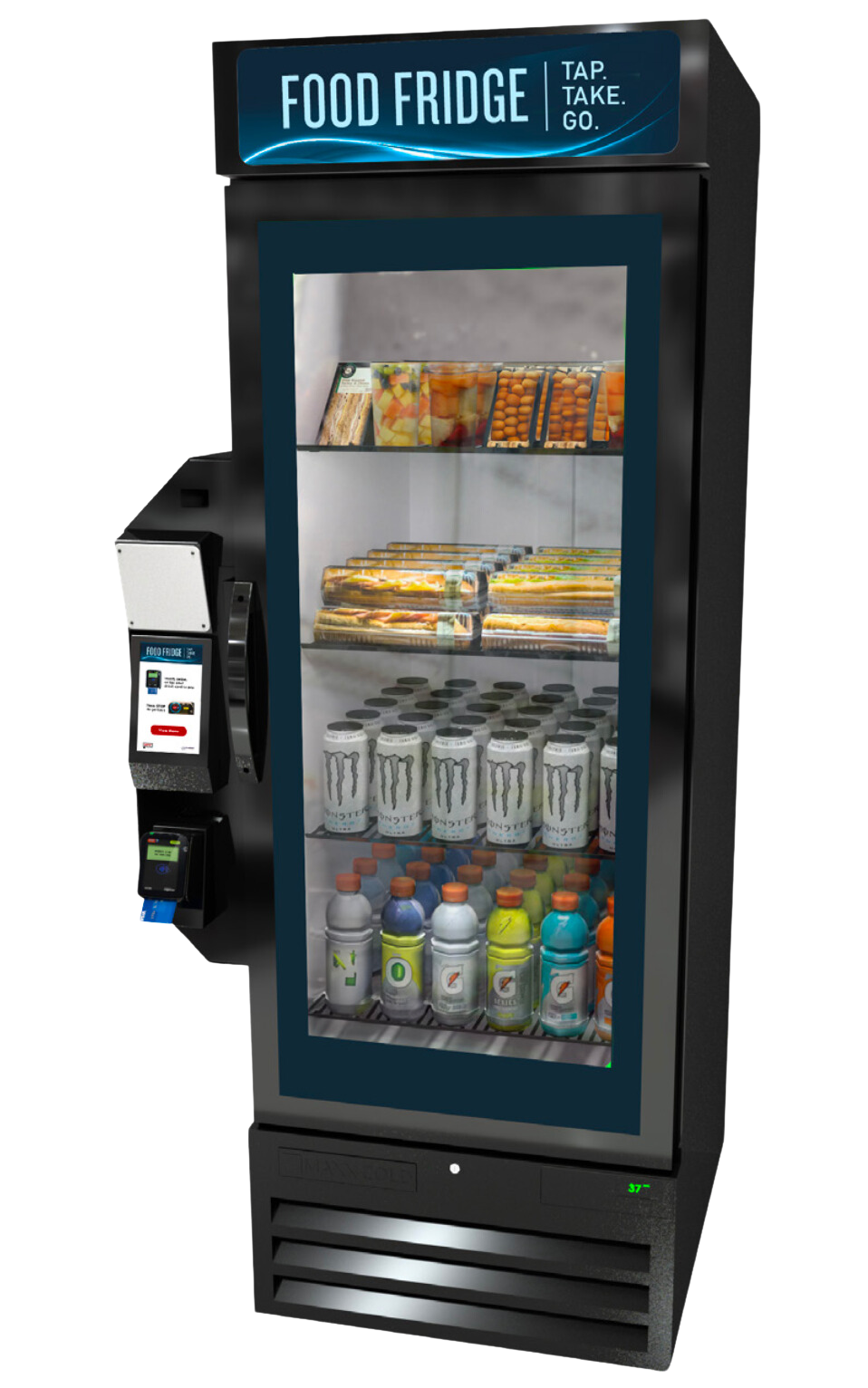 The most significant growth in unattended retail is fresh meal vending serving locations where traditional food service is impractical or unavailable.
Universities and Campus Environments
Residence halls, libraries, and academic buildings operate 24/7 but dining facilities don't. Fresh food vending for universities provides students with healthy grab-and-go meals during late-night study sessions, early mornings, and between classes.
Healthcare Facilities
Hospital staff working overnight shifts, family members in waiting areas, and outpatient visitors need meal access when cafeterias are closed. Smart fresh food solutions for healthcare support 24/7 operations without labor costs.
Corporate Offices
Companies offering employee meal programs can provide subsidized or free meals without operating full cafeterias, reducing overhead while maintaining benefits that support retention and workplace satisfaction.
Manufacturing Facilities
Plants operating multiple shifts require meal access for workers who can't leave facilities during breaks. Smart fresh meal vending for manufacturing supports shift work without dedicated food service staff.
Hotels and Co-Working Spaces
Hotels serve guests preferring convenient alternatives to room service or hotel restaurants. Co-working facilities differentiate their amenities with premium food access without requiring staffed cafés.
Restaurants and Food Service Operators: Revenue Expansion Through Unattended Retail
For established food businesses, smart vending represents channel expansion without new real estate costs. Restaurants extend operating hours beyond kitchen staffing. Caterers place units in office buildings, creating recurring revenue independent of event bookings. Food trucks establish permanent satellite locations serving their menus when trucks aren't physically present.
Beyond Food: Other Automated Retail Applications
While fresh food drives current growth, unattended retail infrastructure supports diverse product categories:
- Electronics and consumer tech in airports and transit hubs provide immediate access to phone chargers, headphones, and travel accessories where rent makes traditional stores uneconomical.
- Personal protective equipment (PPE) in manufacturing and construction sites dispenses safety gear through controlled access systems tracking usage by employee.
- Cosmetics and personal care from premium brands deployed in malls, airports, and hotels where self-service appeals to convenience-focused shoppers.
- Pharmaceuticals and health products in healthcare settings, workplaces, and public venues provide over-the-counter medications and first aid supplies with compliance tracking.
- Retail loss prevention enables high-theft items—razors, infant formula, cosmetics—to be merchandised securely, reducing labor costs while maintaining inventory control.
The Business Case for Automated Retail
Organizations deploy unattended retail to address specific operational challenges:
- Labor cost reduction: 24/7 access without staffing overnight shifts or low-traffic periods
- Real estate efficiency: Revenue per square foot exceeds traditional vending while requiring lower overhead than staffed retail
- Data-driven operations: Real-time sales data enables predictive restocking, spoilage prevention, and customer behavior analytics
- Brand extension: Established businesses reach new locations and customer segments without opening storefronts
- Margin optimization: Capture sales during hours when traditional service is unavailable or uneconomical
Selecting Unattended Retail Technology: Evaluation Criteria
Organizations considering automated retail should assess:
- Technology approach: RFID provides proven item-level tracking reliability; computer vision eliminates tagging but requires more sophisticated software and processing power.
- Deployment scale: Single units versus RFID vending micro markets require assessment of space, traffic, and revenue potential.
- Hardware durability: Commercial-grade refrigeration, public-use-rated touchscreens, and modular components enabling field service without full unit replacement.
- Software capabilities: Cloud platforms supporting multi-location management, integration with existing systems, and data export preventing vendor dependency.
- Operational support: For food service applications, evaluate whether providers offer fulfillment partnerships or require independent operations management.
The Future of Automated Retail
Several trends are shaping unattended retail's evolution:
- Sustainability focus: Smart vending reducing food waste through precise inventory management and dynamic pricing on items approaching expiration.
- Delivery integration: Unattended pickup lockers for delivery orders, ghost kitchen meal dispensing, and hybrid models combining delivery with self-service access.
- Non-traditional locations: Apartment buildings, residential complexes, transit stations, and community spaces becoming retail endpoints.
- Personalization: Loyalty programs, purchase history recommendations, and customized pricing integrated into unattended interfaces.
- Expanded categories: Fresh flowers, local artisan products, restaurant partnership meals, and specialty items previously requiring staffed retail.
REDYREF's Integrated Automated Retail Solutions
REDYREF designs and manufactures integrated unattended retail systems for public and commercial environments, combining commercial-grade hardware, secure payment integration, refrigeration infrastructure, RFID technology, and cloud-based management platforms to support scalable deployments across distributed locations.
Our smart fresh food vending solutions serve operators, food service companies, and facility managers implementing programs ranging from single-location pilots to networks serving thousands of daily transactions.
Whether addressing student meal access, 24/7 healthcare operations, corporate employee programs, or restaurant channel expansion, automated retail systems can be engineered to specific operational requirements and business models.
Frequently Asked Questions
What is automated retail?
Automated retail refers to self-service systems enabling product purchase and dispensing without staff assistance, ranging from traditional vending machines to RFID-enabled smart systems supporting fresh food, high-value products, and sophisticated inventory management.
How does RFID vending work?
RFID vending uses radio-frequency identification tags on individual products. When an item is removed, the system reads the tag, processes payment, and updates inventory in real time without mechanical dispensing.
What types of products work in automated retail?
Fresh and prepared foods, beverages, electronics, cosmetics, pharmaceuticals, PPE, health products, and merchandise suitable for self-service purchase with appropriate environmental controls.
Can restaurants use automated retail to expand their business?
Yes. Restaurants, caterers, and food service operators use smart vending to extend operating hours, reach new locations, and create recurring revenue without opening additional storefronts or staffing overnight shifts.
What's the difference between traditional vending and unattended retail?
Traditional vending relies on mechanical dispensing serving shelf-stable goods. Modern unattended retail uses RFID or computer vision, supports fresh and high-value products, provides real-time inventory management, and enables diverse business models including operator partnerships and branded retail extensions.
Why is automated retail growing now?
Converging factors including labor shortages, rising wages, 24/7 consumer expectations, real estate cost pressure, and demand for data-driven inventory decisions are making unattended retail economically compelling across industries.
Automated retail is not a trend — it is a structural shift in how goods are merchandised, accessed, and distributed in physical environments. Organizations that treat it as infrastructure rather than novelty will be positioned to capture its full economic potential.