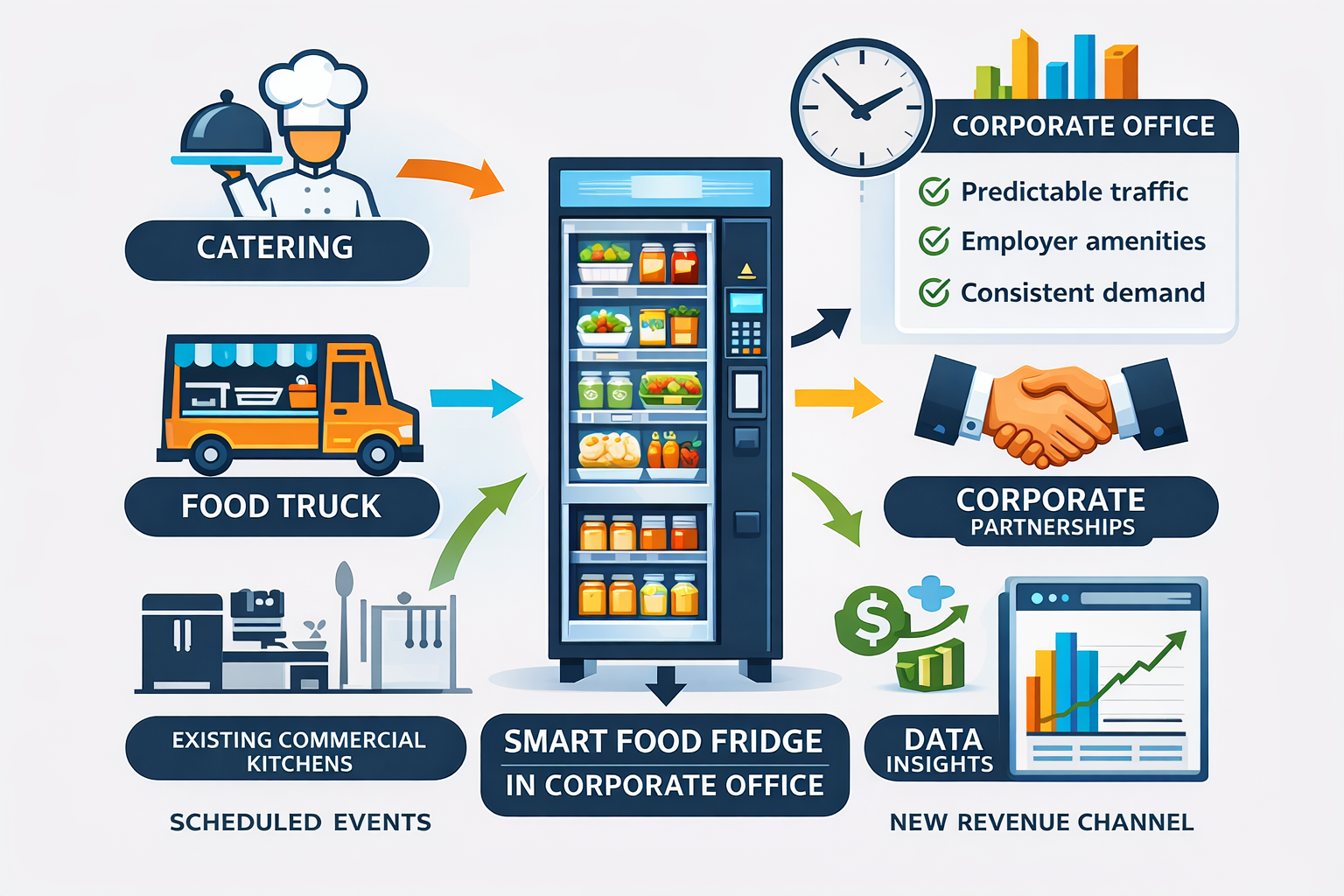
Catering companies and food truck operators excel at providing fresh, quality food for corporate events, lunch service, and scheduled deliveries. The model works well: operators control food preparation, build direct relationships with office managers, and generate substantial revenue from regular corporate clients.
But these relationships are inherently episodic. Catering happens when booked. Food trucks serve during specific lunch windows. Between scheduled services, the relationship goes dormant—and employees still need convenient access to quality food throughout the workday.
Smart food fridges create a new revenue channel that extends food service operators into corporate offices on a continuous basis. Rather than replacing scheduled catering or lunch service, automated refrigerated vending allows operators to maintain brand presence, generate daily revenue, and serve office employees during the hours and days when traditional food service isn't operating.
This isn't about becoming a vending company. It's about leveraging existing commercial kitchen operations, established corporate relationships, and food quality standards to capture a revenue opportunity that previously required either full cafeteria infrastructure or remained unserved.
Why Corporate Offices Are Prime Locations for Smart Food Fridges
 In brief: Offices deliver predictable foot traffic, motivated employers seeking amenities, and opportunities across all company sizes—from small startups to enterprise campuses.
Corporate offices represent one of the most attractive channels for smart food vending deployment because they combine consistent foot traffic, predictable demand patterns, and strong employer motivation to provide food amenities.
Consistent Daily Foot Traffic
Unlike retail locations or public venues where traffic fluctuates, corporate offices deliver predictable daily foot traffic. Employees arrive every weekday, take breaks at similar times, and create reliable demand patterns that allow operators to optimize inventory and minimize waste.
This consistency means operators can dial in exactly what sells, when it sells, and how much inventory to stock—reducing the trial-and-error period common in other venue types.
Multiple Office Sizes, Multiple Opportunities
The corporate office opportunity isn't limited to large enterprises with sprawling campuses. Fresh food vending works across the full spectrum of office environments:
Large corporate campuses (500+ employees): These organizations often operate full cafeterias or food courts, but smart fridges complement rather than compete with central dining. Satellite buildings far from the main cafeteria, manufacturing floors where workers can't leave their posts, and executive areas seeking premium options all represent placement opportunities within a single client.
Mid-size offices (50-200 employees): This segment represents the largest opportunity. These offices are too small to justify full cafeteria operations but large enough that employees need convenient food access beyond bringing lunch from home or leaving the building.
Many mid-size offices already use catering for meetings and events. Smart fridges extend that relationship into daily operations, providing the same food quality employees associate with catered events but available whenever needed.
Small offices and startups (10-50 employees): Smaller offices increasingly compete for talent by offering amenities typically associated with larger companies. A smart fridge stocked with quality prepared meals positions even small companies as employee-focused without requiring kitchen infrastructure or long-term vendor contracts.
For food service operators, small offices offer lower-risk entry points to test the model before approaching larger accounts.
Employer Motivation for Food Amenities
Employers benefit from smart food solutions because they provide amenity value without operational burden. Unlike managing cafeteria vendors or negotiating catering contracts, a smart fridge partnership requires minimal employer involvement once deployed. The operator handles inventory, the technology handles transactions, and the employer gains a recruiting and retention tool.
The Business Model for Food Service Operators
In brief: Leverage existing commercial kitchens, revenue share or location fee agreements, 2–3x weekly restocking instead of daily staffing, and multiple office locations from one prep facility.
Smart fridges in corporate offices work as a revenue channel for food service operators because they leverage existing infrastructure and operations rather than requiring entirely new business capabilities.
Leverage Existing Commercial Kitchen Operations
Catering companies and food trucks already maintain commercial kitchens for food preparation, packaging, and storage. Smart vending deployment in corporate offices utilizes this existing capacity. The same kitchen producing catered meals or food truck inventory can produce grab-and-go items for vending locations during the same prep windows, maximizing facility utilization without requiring additional space or major equipment investment.
Revenue Share or Location Fee Agreements
Corporate office partnerships typically structure as revenue share agreements or flat monthly location fees, depending on office size and foot traffic.
Revenue share models (common with larger offices) split sales revenue between operator and employer, typically 70/30 to 80/20 in the operator's favor. Flat fee models (more common with smaller offices) involve the operator paying a modest monthly fee for the location, retaining all revenue beyond that fixed cost.
Both models avoid the capital intensity and long-term commitment of traditional expansion while providing operators with predictable costs and clear revenue economics.
Restocking Economics vs. Daily Service
Smart fridges require restocking 2–3 times per week—typically 20–30 minutes per location to swap inventory, check equipment, and restock based on sales data. An operator servicing five corporate office locations might invest 3–4 hours weekly in restocking labor, compared to 20–30 hours weekly required to staff a food truck covering similar customer volume.
Multiple Office Locations from Single Prep Kitchen
The same commercial kitchen supporting catering operations can supply multiple smart fridge locations simultaneously. An operator might serve breakfast and lunch via food truck Tuesday through Thursday, cater two corporate events weekly, and stock six smart fridge locations—all from the same kitchen facility, amplifying revenue without proportionally increasing fixed costs.
Quick Self-Assessment: Is This Channel Right for You?
Before exploring corporate office deployments, consider whether your operation aligns with what makes this model work:
- ✓ You already serve corporate clients through catering or food truck service
- ✓ You have a licensed commercial kitchen with excess production capacity
- ✓ Your food quality is consistent and translates well to grab-and-go packaging
- ✓ You can commit to 2–3 weekly restocking visits per location
- ✓ You're seeking recurring revenue that complements event-based service
- ✗ You don't have licensed kitchen facilities or established food safety systems
- ✗ Your food quality varies depending on circumstances
- ✗ You need immediate high-volume revenue to justify investment
- ✗ You have no corporate market access or existing office relationships
If you checked most items in the first list, corporate office smart fridges likely represent a strategic opportunity. If you checked multiple items in the second list, this channel may not align with your current business model.
How Caterers and Food Trucks Are Using This Channel
In brief: Extending existing catering relationships, maintaining food truck customer connections, entering new accounts without competing for catering contracts, and gathering menu data from actual employee purchasing decisions.
Food service operators are implementing smart fridges in corporate offices in ways that complement rather than compete with their core operations.
Extending Existing Catering Relationships
Many corporate office smart fridge deployments begin with existing catering clients. Employees who enjoy Tuesday's catered lunch can purchase similar menu items from the fridge on Wednesday, Thursday, and Friday. The catering relationship continues generating event-based revenue while the fridge generates incremental daily revenue from the same client.
When employees have consistent access to an operator's food through vending, the operator becomes the obvious choice when new catering needs arise.
Maintaining Food Truck Customer Relationships
Food trucks that serve corporate office parks during lunch rushes can place smart fridges in multiple buildings within that same park. Employees who buy from the truck twice weekly become repeat customers at the fridge on other days. The truck creates brand awareness; the fridge captures demand when the truck is elsewhere.
Entering New Corporate Accounts Without Catering Competition
Smart fridges offer an entry point that doesn't compete with existing catering arrangements. An operator can propose a smart fridge pilot focused on daily employee convenience rather than replacing scheduled catering. If the fridge performs well, catering opportunities may develop naturally—but the fridge generates revenue regardless.
Menu Testing and Customer Data
Smart fridges generate real-time sales data showing exactly what office employees purchase, when they purchase it, and what sits unsold. If a new salad concept sells extremely well in vending, operators know there's demand before featuring it as a catered option.
Traditional catering provides limited menu feedback because clients order specific items for events. Smart fridges show what individuals choose when making personal purchase decisions.
What Makes Corporate Office Partnerships Work
In brief: Technology that handles operations, aligned incentives through partnership structure, and low friction for both operators and employers.
Successful smart fridge deployments in corporate offices balance operator needs, employer priorities, and employee preferences through technology and partnership structure.
Why Smart Vending Technology Makes This Model Viable Now
Ten years ago, the corporate office smart fridge model wasn't practical for most food service operators. Traditional vending machines required cash handling, manual inventory tracking, and limited visibility into what sold.
RFID vending technology changed the economics entirely. Modern smart fridges automatically track every item loaded and purchased, process cashless payments, monitor equipment health remotely, and provide real-time sales data accessible from any device.
This technology infrastructure means operators can manage multiple office locations without being physically present during business hours. The friction that once made small-scale vending unworkable has been eliminated through automation.
The result isn't more dashboards to monitor—it's fewer surprises, more efficient restocking routes, and the ability to scale locations without proportionally scaling operational complexity.
Employer and Operator Benefits Through Partnership Structure
Corporate employers gain amenity value without operational burden—no managing vendors, no kitchen maintenance, no long-term contracts. If the arrangement doesn't work, removing a smart fridge is far simpler than exiting cafeteria contracts.
Food service operators gain predictable revenue without daily presence. Corporate offices provide climate-controlled, secure environments with consistent demand patterns. Serving an office daily creates stronger brand relationships than episodic catering—employees become advocates who request the operator for catering and provide word-of-mouth marketing.
Successful partnerships structure trial periods (60–90 days), employer promotion through internal communications, menu collaboration based on employee preferences, and regular feedback loops that strengthen relationships over time.
Corporate Office Requirements and Considerations
In brief: Modest space and power requirements, menu strategies for office environments, and standard food safety compliance that catering operators already maintain.
Space and Infrastructure Requirements
Standard smart food fridges require 10–15 square feet of floor space, standard 110V electrical outlets, and internet connectivity for payment processing. Units should be located where employees naturally gather—break rooms, common areas near elevators, or lobbies.
Menu Considerations for Office Environments
Corporate office menus differ from catering menus in ways that affect sales performance:
- Breakfast options for early-arriving employees (sandwiches, yogurt parfaits, fresh fruit)
- Lunch variety to prevent menu fatigue while maintaining core favorites
- Afternoon snacks and early dinner for employees working late
- Dietary accommodations (vegetarian, gluten-free, clear allergen labeling)
- Portion sizing matching individual appetite and price sensitivity
Health, Safety, and Licensing Compliance
Food service operators deploying smart fridges must maintain the same health and safety standards required for catering operations. Operators already licensed for catering typically meet all requirements for smart fridge deployment without additional licensing. Commercial kitchen licensing, food safety protocols, liability insurance, and health inspection readiness all translate directly from catering to vending operations.
Who This Model Works For (and Who It Doesn't)
Understanding whether corporate office smart fridges align with your business helps avoid investing time in a model that doesn't fit.
This Model Works Best For:
- Catering companies and food trucks already serving corporate clients with established brand recognition
- Operators with licensed commercial kitchens and excess production capacity
- Food businesses focused on quality and consistency
- Operators seeking recurring revenue that complements event-based service
- Businesses with existing food safety systems
This Model Doesn't Work Well For:
- Operators without licensed commercial kitchen facilities
- Businesses struggling with food quality consistency
- Operators seeking immediate high-volume revenue
- Food service providers without corporate relationships or office market access
- Businesses unable to commit to 2–3 weekly restocking
What to Evaluate Before Your First Pilot
If corporate office smart fridges align with your food service operation, the path forward starts with strategic pilot deployment.
Questions to Answer Before Approaching Offices:
- Do you have a corporate client who already trusts your food quality? Starting with an existing catering client dramatically improves pilot success.
- Can your commercial kitchen handle additional production without major changes? Smart fridge inventory should integrate into existing prep workflows.
- What menu items travel well and maintain quality for 48–72 hours? Identify items that maintain appearance, texture, and food safety through refrigerated storage.
- What's your restocking capacity? Map restocking routes to confirm operational feasibility before committing to additional locations.
- What revenue threshold makes pilot deployment worthwhile? Understanding your minimum acceptable return helps evaluate whether pilot performance justifies expansion.
Common First-Pilot Mistakes to Avoid:
- Treating the fridge like a refrigerator rather than a channel: Successful operators actively manage inventory, rotate items based on sales data, and adjust menus based on employee feedback.
- Under-promoting during the pilot: Employees need to know the fridge exists, what's inside, and when it's restocked.
- Ignoring sales data: Smart fridges generate detailed data showing what sells, what sits, and when purchases happen. Operators who don't analyze this data miss the primary advantage technology provides.
- Pilot duration too short: 60–90 days allows employees to discover the fridge, try multiple menu items, and establish purchasing patterns.
- Extending Your Food Service Business Into Corporate Offices
Smart food fridges in corporate offices don't replace catering companies' core event-based business or food trucks' mobile service model. They extend existing food service operations into continuous daily revenue channels that leverage the same commercial kitchens, food preparation expertise, and quality standards operators already maintain.
The corporate office food service market continues to evolve, driven by employer competition for talent and employee expectations for workplace amenities. Smart fridges offer food service operators a channel that scales beyond event-based service while maintaining the quality, brand identity, and customer relationships that define successful catering companies and food trucks.
For operators ready to explore this revenue channel, the path forward starts with existing corporate relationships, strategic pilot deployments, and the operational discipline to treat smart fridges as a business channel rather than passive vending. For operators willing to treat smart fridges as a disciplined revenue channel—not a passive amenity—the opportunity isn't theoretical. It's operational.