Food trucks revolutionized the restaurant industry by proving that mobility, personality, and quality food could build loyal customer bases without the overhead of traditional brick-and-mortar locations. The model works: lower capital requirements, operational flexibility, direct customer relationships, and the ability to test markets and menu concepts quickly.
But when successful food truck operators look to scale, they face a difficult choice. Opening a restaurant requires hundreds of thousands of dollars in capital, a completely different operational model, and the loss of the flexibility that made the truck successful in the first place. Buying a second truck doubles labor costs, insurance, maintenance, and logistical complexity while the operator divides attention between two mobile operations.
An emerging alternative is changing how food truck operators think about growth:
smart fresh food vending
and automated kiosks that extend brand presence, generate revenue in multiple locations, and scale without the capital intensity or operational burden of traditional expansion.
This isn't about replacing the truck. It's about building a distributed food business model where a central prep kitchen supplies both mobile truck operations and strategically placed automated vending locations—creating multiple revenue streams without proportionally scaling labor and overhead.
TL;DR: Food trucks struggle to scale because restaurants kill flexibility and second trucks double labor costs. Smart vending offers a third path—extending a food truck's brand into fixed locations using the same prep kitchen, without proportional labor scaling or the capital risk of traditional expansion. Operators maintain control over food quality while technology handles sales, inventory, and payment processing at multiple locations simultaneously.
Why Traditional Scaling Doesn't Work for Most Food Truck Operators
The food truck business model succeeds precisely because it avoids the constraints of traditional restaurants. When operators try to scale using conventional approaches, they often undermine the advantages that made the truck profitable.
The Restaurant Path
Opening a brick-and-mortar restaurant requires significant capital investment—typically $250,000 to $500,000 or more depending on location, size, and concept. This investment covers build-out, equipment, furniture, permits, and initial operating capital. For a food truck operator accustomed to $50,000–$100,000 total investment, this represents a fundamentally different financial risk profile.
Beyond capital, restaurants operate differently. Location becomes permanent rather than flexible. Fixed overhead replaces variable costs. Staff management becomes more complex. The agility and customer connection that defines food truck culture often diminishes in a traditional restaurant setting.
Many food truck operators got into the business specifically to avoid these constraints. Scaling into a restaurant means adopting the very model they intentionally left behind.
The Second Truck Path
Buying and outfitting a second food truck appears more aligned with the existing business model, but it introduces its own scaling challenges. A second truck means:
- Doubled labor costs (full crew for each truck)
- Split operational attention (owner can't be in both places)
- Increased insurance, maintenance, and permitting costs
- More complex logistics (multiple vehicles, equipment, routes)
- Diluted brand consistency without direct owner oversight
Some food truck operators successfully scale to multiple trucks, but it requires strong systems, excellent staff, and fundamentally different management skills than running a single truck where the owner is present daily.
The Capital and Risk Problem
Both traditional scaling approaches—restaurants and additional trucks—require substantial capital investment with long payback periods. They also commit operators to specific locations, lease terms, or operational models that reduce flexibility.
For food truck operators who value adaptability and direct control, these scaling paths often feel like compromises that sacrifice what made the original business appealing.
The Smart Vending Model for Food Trucks
Smart food vending
and automated kiosks offer a different approach: extending brand presence and generating revenue without the capital intensity, labor scaling, or operational rigidity of traditional expansion.
How the Model Works
In this model, the food truck operator continues to operate from a central prep kitchen—preparing food, maintaining quality standards, and managing inventory. From that kitchen, product goes to two channels:
The mobile truck continues operating as before: events, lunch service, dinner shifts,
catering,
wherever the operator sees opportunity and demand.
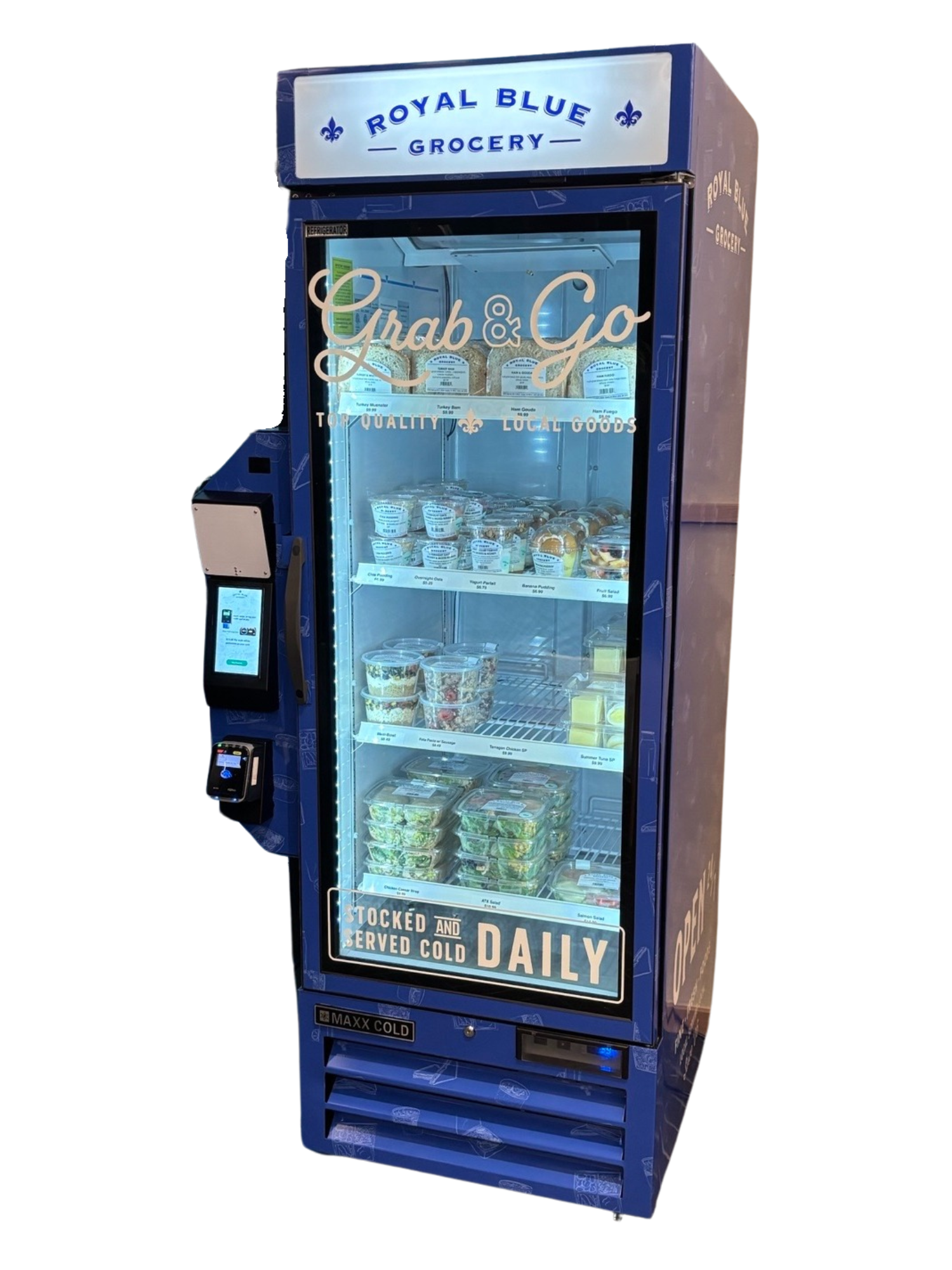
Automated vending locations receive pre-portioned, packaged menu items that customers purchase 24/7 through smart kiosks equipped with refrigeration, payment processing, inventory tracking, and remote monitoring.
The operator controls food preparation and quality. The technology handles transactions, inventory reporting, and customer interaction. Location partners provide space and foot traffic in exchange for amenity value or revenue share.
What Smart Vending Technology Provides
Modern fresh food vending technology
differs substantially from traditional vending machines. Smart kiosks and refrigerated vending units offer:
- Real-time inventory tracking and low-stock alerts
- Cashless payment processing
- Remote monitoring and diagnostics
- Customer data and purchasing patterns
- Integration with point-of-sale and accounting systems
- Temperature control and food safety monitoring
RFID technology
enables particularly sophisticated inventory management, automatically tracking each item as it's loaded and purchased, eliminating manual counting and providing real-time sales data.
The result isn't more dashboards—it's fewer surprises, fewer wasted trips, and tighter control over food cost.
This technology infrastructure means operators can manage multiple vending locations without being physically present.
Food Truck Evolution, Not Replacement
Smart vending doesn't replace food trucks. It extends the food truck business model into spaces and times the truck can't occupy—turning one great food truck into a distributed food brand without losing what made it great.
If you're exploring what this model could look like for your operation, key considerations include location partnerships, technology integration, and a vending partner like REDYREF who understands food quality and operator priorities.