Smart vending machines are automated retail kiosks that use RFID tracking, cloud-based management, and secure cashless payment to sell virtually any product without staff — from fresh meals and hot coffee to electronics, cosmetics, and high-value items previously locked behind security glass. Where traditional vending is limited to packaged snacks dropped from a spiral coil, smart vending is a connected retail platform: it knows exactly what's in stock, charges customers only for what they take, and reports everything to an operator's dashboard in real time.
For businesses, that solves several problems at once: 24/7 product access without labor costs, theft prevention that improves the customer experience instead of degrading it, and product-level sales data that turns vending from a static amenity into a measurable retail channel. This guide explains what smart vending machines are, how they work, the types available, what they cost, and how organizations across industries are deploying them.
What Are Smart Vending Machines?
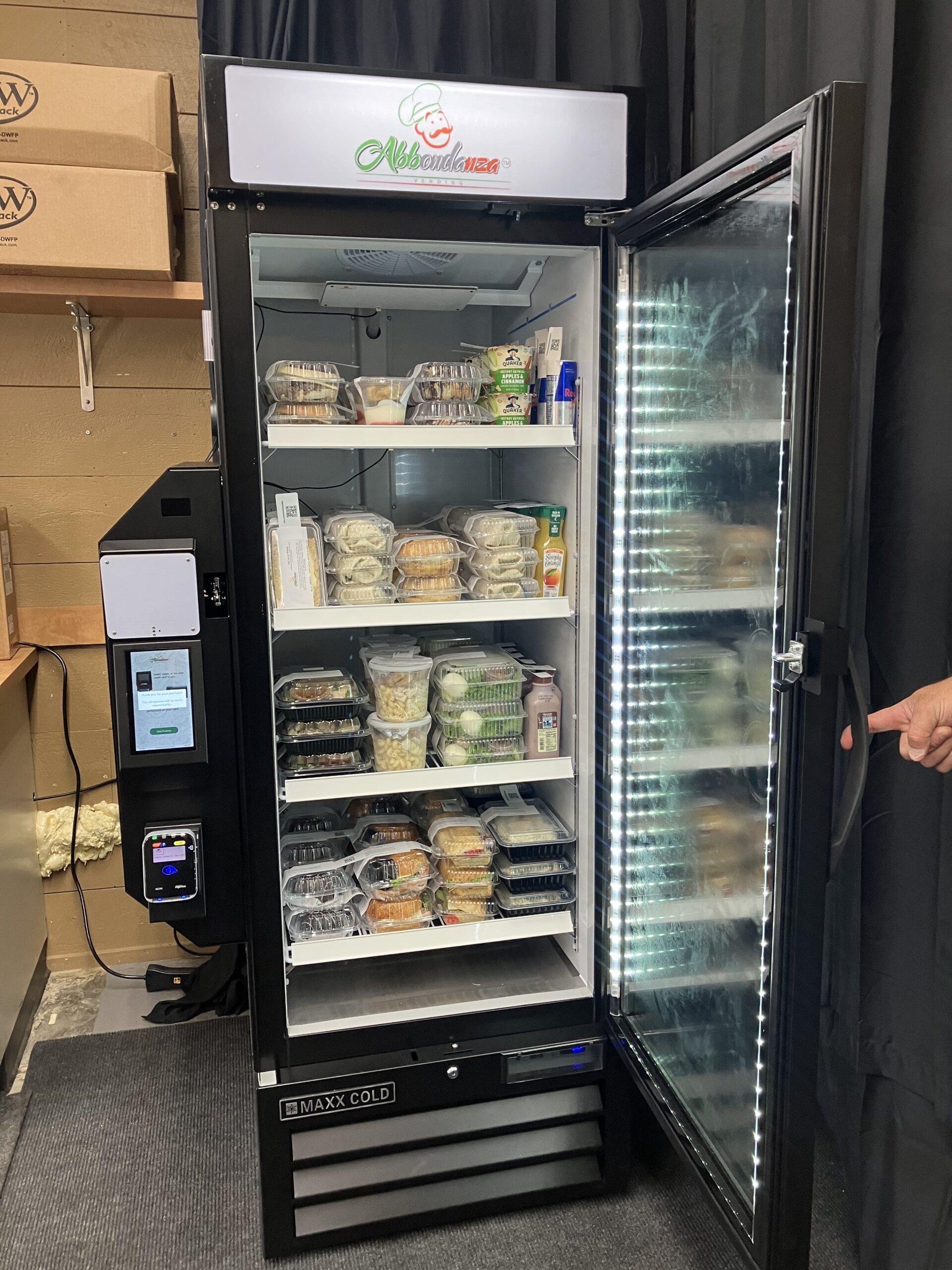 Smart vending machines are automated retail kiosks that dispense products without human assistance while providing capabilities impossible in traditional vending: real-time inventory tracking, remote monitoring, multiple secure payment options, and the ability to vend products of virtually any size or value.
The key distinction between traditional and smart vending is the integration of technologies that enable:
- RFID (Radio Frequency Identification) tracking of individual items, providing instant inventory updates and preventing theft
- Remote monitoring and management allowing operators to track sales, inventory, and machine health from anywhere
- Advanced payment systems accepting credit/debit cards, mobile payments, and contactless options beyond just cash
- Data analytics showing purchasing patterns, peak usage times, and product performance
- Flexible product sizing not constrained by mechanical dispensing slots
- Temperature control for perishable items when needed
Smart vending machines can dispense fresh food, hot beverages, electronics, cosmetics, office supplies, personal protective equipment, pharmaceutical products, and high-value retail items — essentially any product that benefits from secure, unattended sales with automated inventory management.
The technology has evolved beyond "better vending machines" into a retail platform that solves problems across multiple industries: reducing labor costs in workplace environments, preventing retail theft while maintaining customer access, providing 24/7 product availability in hotels and airports, and creating unattended retail opportunities in locations where staffed stores aren't viable.
How Smart Vending Machines Work
Understanding the operational technology behind smart vending helps businesses evaluate whether these systems fit their needs and what advantages they offer over traditional solutions.
RFID Technology: The Foundation of Smart Vending
Radio Frequency Identification (RFID) is the core technology that makes smart vending possible. Here's how it works:
Product tagging: Each item receives an RFID tag — a small chip that contains a unique identifier, product information, price, and in some cases expiration date. These tags are either embedded in packaging during manufacturing or applied by the operator during stocking.
Reader detection: RFID readers installed throughout the vending machine emit radio frequency signals that activate the tags. When a product comes within range, its tag responds with its unique identifier, allowing the system to know exactly which items are present.
Real-time inventory: As products are loaded, the RFID system automatically detects and catalogs every item without manual scanning. When items are removed, the system instantly updates inventory counts and triggers restocking alerts when quantities fall below defined thresholds.
Automatic checkout: In "open door" RFID systems like REDYREF's Smart Fresh Food Fridge, customers tap their payment card, open the door, take what they want, and close the door. The RFID system detects exactly which items were removed and charges the customer accordingly — no barcode scanning required.
This technology is far more reliable than camera-based systems (which struggle with lighting variations and similar-looking products) and more accurate than weight sensors (which can't distinguish between products of similar weights). RFID has been proven across retail and logistics industries for decades, making it the most dependable technology for smart vending applications.
Payment Processing and Security
Modern smart vending machines support multiple payment methods through integrated processing systems:
EMV-certified card readers accept credit and debit cards via chip, swipe, and contactless NFC for mobile payments (Apple Pay, Google Pay, Samsung Pay). The systems are PCI DSS compliant, meaning payment data is encrypted and secure.
Pre-authorization: Before the machine unlocks, the payment method is verified and authorized, preventing fraud from declined payments after products are taken.
Employee integration: Many workplace installations integrate with employee badge systems, allowing purchases to be charged to payroll deduction accounts or meal stipend programs without requiring employees to carry payment cards.
Transaction security: Built-in cameras capture each transaction for dispute resolution, while secure cloud platforms ensure all payment data is transmitted and stored with enterprise-grade encryption.
Remote Monitoring and Cloud-Based Management
Smart vending systems connect to cloud-based management platforms that provide operators with complete visibility and control:
Real-time dashboard access from any internet-connected device shows current inventory levels, recent sales, machine health status, and alerts requiring attention.
Automated alerts notify operators of conditions requiring action: low inventory on specific products, temperature fluctuations in refrigerated units, payment system issues, or mechanical problems.
Sales analytics track which products sell best, peak usage times, revenue by location, and customer purchasing patterns — data that helps optimize product selection and pricing.
Remote configuration allows operators to change pricing, update product information, modify promotional displays, and adjust operational parameters without visiting the machine.
Multi-location management enables operators with machines across different buildings, cities, or regions to manage their entire fleet from a centralized platform, optimizing restocking routes and standardizing operations.
The Complete Transaction Flow
Here's what happens during a typical smart vending transaction:
- Customer approaches and browses available products via touchscreen display showing items, prices, nutritional information, and availability
- Payment authorization occurs when customer taps/inserts payment card — the system verifies funds before proceeding
- Access granted — the machine unlocks, allowing the customer to open the door
- Product selection — customer takes desired items (in open-door RFID systems) or the machine dispenses selected items (in compartment-based systems)
- Automatic detection — RFID readers identify exactly which products were removed
- Payment processing — the customer is charged only for items taken
- Inventory update — the system immediately updates inventory counts and sends data to the cloud platform
- Transaction complete — door locks, receipt is offered (printed or emailed), and the machine is ready for the next customer
This entire process typically completes much faster than traditional vending with mechanical dispensing and change-making, improving customer experience and throughput during peak times.
Key Features of Smart Vending Machines
Understanding the specific features that define smart vending helps businesses identify which capabilities matter most for their applications.
RFID Inventory Management
Real-time tracking of every item provides unprecedented visibility into stock levels and product performance. The system knows exactly what's in stock at any moment, which items are selling quickly, and which are moving slowly. This enables:
Predictive restocking based on consumption patterns rather than fixed schedules — if Tuesday lunch sales consistently deplete chicken wraps by 2pm, the system recommends increased Tuesday stocking.
Waste reduction particularly for perishable goods, where the system tracks product age and can prevent sales of items approaching expiration or generate removal alerts for operators.
Theft prevention since the system requires payment authorization before access and automatically charges for items removed, significantly reducing shrinkage compared to traditional retail or vending.
Audit trail providing complete transaction history showing what was sold, when, to whom (if using employee badge integration), and at what price — critical for regulated industries or facilities requiring detailed accountability.
Remote Monitoring and Management
Cloud connectivity transforms vending from "visit to check" to "monitor continuously and visit only when needed":
Equipment health monitoring tracks compressor performance in refrigerated units, payment system status, network connectivity, and mechanical components — alerting operators to potential issues before they cause downtime.
Temperature logging for refrigerated units provides documented compliance with food safety regulations, with automated alerts if temperature drifts outside safe ranges (typically 35–41°F for refrigerated, 0–10°F for frozen).
Service optimization uses data to schedule preventive maintenance during low-traffic periods and prioritize service calls based on revenue impact rather than just chronological order.
Performance benchmarking across multiple locations helps identify top-performing machines to replicate their success factors (product mix, placement, pricing) and underperforming units that need attention.
Multiple Secure Payment Options
Accepting diverse payment methods removes friction from the purchasing process:
Contactless payments via NFC are increasingly the customer default — a tap of a phone or card with no shared-surface contact and no fumbling for cash.
Mobile wallet integration works with Apple Pay, Google Pay, Samsung Pay, and other digital wallet services, appealing to younger demographics who rarely carry physical cards.
Employee systems integration allows badge-tap payment in workplace installations, eliminating the need for employees to carry wallets while working and enabling meal stipend programs.
Subscription and loyalty programs can be implemented through the payment system, offering regular customers discounted pricing or prepaid access.
Split payments and group purchases enable more sophisticated transaction types than traditional vending — useful in settings like universities where students might share meal costs.
Advanced Security and Fraud Prevention
Multiple security layers protect both the operator's inventory and customers' payment data:
Pre-authorization verifies payment methods before granting access, preventing the "grab and run" scenario where someone takes products then uses a declined card.
Transaction photography via built-in cameras provides visual records of each transaction, deterring theft and enabling dispute resolution if customers claim incorrect charges.
Tamper detection through multiple sensors alerts operators to attempts to damage or bypass the system, while secure lock mechanisms keep machines locked during power failures or system shutdowns.
Payment security meets PCI DSS standards with encrypted transmission, tokenization of card data, and secure cloud storage ensuring customer payment information is never exposed.
Access controls implement role-based permissions so different users (operators, restockers, managers, support technicians) only have access to functions appropriate to their role.
Customizable Inventory and Dynamic Pricing
Unlike traditional vending with fixed product slots, smart vending offers complete flexibility:
Product variety isn't constrained by mechanical spiral dispensers or fixed compartment sizes — products of any size can be stocked as long as they fit the physical space.
Menu customization based on location, time of day, season, or customer demographics allows different products in different places or promotional items during specific periods.
Dynamic pricing enables time-based pricing (breakfast items discounted in morning, salads promoted at lunch), promotional pricing for slow-moving items, or premium pricing for high-demand products.
A/B testing of products, pricing, and placement helps optimize offerings based on actual sales data rather than assumptions about what customers want.
Seasonal rotation makes it easy to swap product offerings as preferences change throughout the year without reconfiguring mechanical systems.
Temperature Control for Diverse Products
Professional smart vending systems offer precise climate control for products requiring specific storage conditions: refrigerated units for fresh food, beverages, dairy, and pharmaceuticals; frozen units for ice cream and frozen meals; ambient zones for shelf-stable products like electronics, cosmetics, and packaged goods; and multi-zone systems that combine different temperature zones in a single unit. Multiple sensors ensure consistent climate control, with automated drift alerts and documented logging for regulatory compliance.
Data Analytics and Consumer Behavior Tracking
The intelligence gathered from smart vending provides business insights impossible with traditional systems:
Sales patterns showing peak usage times, popular products by location/time/demographic, and seasonal trends help optimize stocking and pricing.
Customer journey data tracks how long customers spend selecting products, which items they consider then reject, and purchasing patterns over time.
Product performance metrics identify winners and losers in the product mix, enabling data-driven decisions about what to stock more or less of.
Revenue optimization uses historical data to predict future demand, preventing both stockouts (lost sales) and overstocking (waste and capital tied up).
This data creates a feedback loop where each sale improves future decisions about inventory, pricing, and product selection.
Types of Smart Vending Machines
 Smart vending technology adapts to virtually any product category. Understanding the different types helps businesses identify which applications fit their needs.
1. Fresh Food and Refrigerated Vending Machines
These machines provide restaurant-quality meals in a grab-and-go format, using commercial refrigeration and RFID tracking to ensure food safety and freshness.
Product range: Salads, sandwiches, wraps, prepared meals, fresh fruit, yogurt, beverages, and grab-and-go breakfast items prepared daily and delivered multiple times weekly.
Technology features: Precise temperature control, RFID expiration tracking preventing sale of items approaching use-by dates, automated removal alerts for food safety compliance, and real-time inventory management ensuring popular items stay in stock.
Ideal applications: Corporate offices, healthcare facilities, universities, manufacturing plants, and any location where employees need access to quality meals during extended or non-traditional hours when cafeterias are closed.
Business advantages: Provides cafeteria-quality food service without labor costs, serves 24/7 including nights and weekends, accommodates diverse dietary needs (vegan, gluten-free, allergen-friendly), and supports workplace wellness initiatives with nutritious options.
REDYREF's Smart Fresh Food Fridge exemplifies this category, combining RFID technology with commercial refrigeration to deliver fresh meals with the "open door, take what you want, automatic checkout" convenience that defines modern smart vending.
For more details, see our complete guide to fresh food vending machines.
2. Retail Loss Prevention Vending
 One of the fastest-growing applications of smart vending is replacing locked retail security cases with RFID-enabled self-service access.
The problem being solved: Retailers increasingly lock high-theft items (razors, cosmetics, baby formula, birth control) behind plexiglass cases requiring employee assistance. This creates a terrible customer experience — waiting for staff, staff shortage frustrations — while still not completely preventing theft.
The smart vending solution: High-theft items are placed in RFID-enabled smart vending units. Customers tap their payment card, the door unlocks, they take what they need, the door closes, and the charge is automatic. No employee assistance required, no waiting, complete theft prevention through mandatory payment.
Product categories:
- Personal care (razors, electric toothbrushes, premium cosmetics)
- Pharmacy items (birth control, morning-after pills, premium supplements)
- Baby products (formula, specialty feeding items)
- Electronics accessories (phone chargers, headphones, batteries)
- Luxury items (premium sunglasses, watches, designer fragrances)
Ideal applications: Pharmacy chains, grocery stores, airport retail, hotel shops, convenience stores in high-theft areas, and any retail environment struggling with shrinkage on specific product categories.
Business advantages: Eliminates the need for staff to unlock cases (reducing labor costs and customer frustration), provides a better customer experience than locked cases, tracks exactly what's being taken and by whom, and recovers costs through actual sales rather than losses.
This application represents a fundamental shift in retail loss prevention — from "lock it up and make it inconvenient" to "secure access with better customer experience."
Beyond Food and Retail: Other Smart Vending Categories

The same platform extends across product categories: hot beverage and coffee systems that brew bean-to-cup drinks in offices and facilities; on-demand hot food units that prepare meals in minutes where no kitchen exists; workplace essentials vending for office supplies, PPE, and IT accessories with badge-tracked accountability; electronics vending in airports and hotels for chargers, headphones, and travel tech; and personal care vending for cosmetics, hygiene products, and over-the-counter items in gyms, hotels, and campuses.
Each category uses the same core technologies — secure payment, inventory tracking, remote management — configured for different products, operating environments, and customer workflows. For RFID-based configurations across these categories, see our RFID-enabled smart vending kiosks and smart vending machine kiosk pages.
Smart Vending vs. Traditional Vending: Understanding the Difference
Many businesses have traditional vending machines and wonder whether smart vending offers enough advantages to justify upgrading. Here's a comprehensive comparison:
Technology and Capabilities
Traditional vending uses mechanical systems developed in the 1960s–1980s: spiral coils that push products forward, mechanical coin acceptors, basic LED displays showing prices, and no connectivity beyond a phone call when something breaks. Inventory management means someone physically opening the machine and counting what's left.
Smart vending integrates modern technology: RFID or weight sensors tracking every item automatically, touchscreen displays showing product information and nutritional data, cloud connectivity enabling remote monitoring, and sophisticated analytics providing business intelligence. Operators know what's in every machine from their phone without visiting the location.
The technology gap is similar to comparing a rotary phone to a smartphone — both make calls, but one does exponentially more.
Product Flexibility and Variety
Traditional vending is constrained by mechanical dispensing systems. Products must fit specific slot sizes, withstand the drop from dispensing mechanisms, and be packaged durably enough to survive spiral coil pushing. This limits offerings to packaged shelf-stable items that can handle rough treatment.
Smart vending has no mechanical dispensing constraints. Products can be any size or shape that fits the physical space. Fresh food works fine because there's no dropping or mechanical pushing. Fragile items like electronics or cosmetics aren't damaged by dispensing mechanisms. Multiple units of the same product can be stacked together without individual slots.
This flexibility means smart vending can offer significantly greater product variety in the same physical footprint compared to traditional vending.
User Experience
 Traditional vending requires customers to:
- Read small LED displays showing limited product info
- Make selections via alphanumeric keypads (A3, B7, etc.)
- Insert cash or swipe cards (many don't accept contactless payments)
- Watch their product mechanically dispense
- Deal with mechanical failures where products get stuck
- Have no recourse if the wrong product dispenses
Customer frustration is common enough that "vending machine rage" is a recognized phenomenon.
Smart vending provides:
- Large touchscreen displays with product photos and detailed information
- Intuitive selection similar to using a tablet or phone
- Multiple payment options including contactless and mobile wallets
- In RFID systems, simply opening the door and taking what you want
- Automatic charging only for items actually taken
- Transaction records via email receipt if disputes arise
The experience feels like using a well-designed app rather than operating old mechanical equipment.
Inventory Management and Operational Efficiency
Traditional vending runs on a "visit to find out" model: operators drive to each machine to check what needs restocking, count inventory by hand, guess at what products to bring, and discover mechanical problems only when machines stop working — with no data about what's selling versus sitting on shelves.
Smart vending inverts that model: real-time inventory from any location, automated restocking alerts, sales data showing what's moving, predictive recommendations based on consumption patterns, and remote problem diagnosis that eliminates unnecessary service trips. Operators spend their time restocking and servicing rather than checking and traveling.
Revenue and Business Intelligence
Traditional vending generates revenue but provides almost no business intelligence — operators know total cash collected but have limited visibility into which specific products sold, when peak times occur, or how different locations compare.
Smart vending provides product-level sales data, revenue by machine and location, customer behavior patterns, cross-location performance comparisons, and margin analysis by product — intelligence that transforms vending from "place and hope" into data-driven retail optimization.
Reliability and Maintenance
Traditional vending mechanical systems eventually fail — spirals jam, coin mechanisms break, refrigeration compressors fail, and bills get stuck. Customers discover these problems, not operators, leading to "out of service" signs and lost revenue.
Smart vending has fewer mechanical failure points (especially RFID systems with no dispensing mechanisms) and provides predictive maintenance alerts before problems impact operations. Remote diagnostics often resolve issues without site visits. While no system is failure-proof, smart vending typically achieves higher uptime through better monitoring and preventive maintenance.
Cost Considerations
Traditional vending has lower upfront equipment costs ($3,000–$5,000 per machine) but higher ongoing operational costs due to service call frequency, mechanical repairs, and inefficient restocking requiring more labor hours.
Smart vending requires higher initial investment ($7,500–$15,000+ per machine depending on features and capacity) but lower ongoing costs through operational efficiency, fewer service calls, and optimized restocking. Many operators find smart vending reaches cost parity with traditional systems within 18–24 months, then becomes more profitable due to operational savings.
For new deployments, smart vending often makes financial sense from day one. For replacement of existing traditional machines, the business case depends on remaining useful life of current equipment and operational cost analysis.
Environmental Impact
Traditional vending machines often run refrigeration compressors 24/7 regardless of usage, use incandescent or fluorescent lighting, and have no power management capabilities.
Smart vending incorporates energy-efficient features: LED lighting, compressor cycling based on actual need, sleep modes during low-traffic periods, remote monitoring that identifies inefficient units for repair, and vacuum insulation in refrigerated units. Energy costs for smart vending are typically lower than traditional machines of similar size.
Benefits of Smart Vending Machines
The features above translate into a handful of business outcomes worth stating plainly.
Personalized Retail at Machine Scale
Each machine can stock what its specific audience actually wants — healthy lunches in an office, travel essentials in a hotel, protein and recovery items in a gym — all running on the same connected platform, with digital menus surfacing nutrition details, dietary filters, and availability before purchase.
24/7 Access Without Abandoning Control
Night-shift workers, weekend staff, and late travelers get meals and essentials outside staffed hours, while temperature monitoring, expiration tracking, and remote alerts keep quality and compliance intact even when nobody is physically watching the machine.
Labor and Waste Savings
The most direct savings come from removing staff from routine transactions — nobody unlocking cases, distributing supplies, or running a low-volume retail counter. Restocking based on actual consumption rather than fixed schedules cuts both overstocking waste and stockout losses, which matters most for fresh food, PPE, and supplies where each has a real cost.
Vending as a Measurable Retail Channel

Product-level data — what sells, when, where, and at what margin — supports pricing decisions, product testing, and location-specific merchandising. Vending stops being a static amenity and becomes a channel that can be managed and optimized like any other.
A Workplace Amenity That Pulls Its Weight
Convenient access to meals, supplies, and personal items reduces friction during the workday, especially in large facilities where leaving during breaks is difficult — and it makes wellness programs practical by putting better options where employees actually are, when they actually need them.
Where Smart Vending Works: Industry Applications
Smart vending solves a different core problem in each environment, but the pattern is consistent: product access without staffing, accountability without friction.
Workplaces — offices, manufacturing, healthcare use smart vending to feed people who can't leave: fresh food for night-shift nurses and plant workers, badge-integrated purchases charged to payroll or meal programs, and PPE or supply dispensing with automatic accountability by department. The cafeteria closes at 2pm; the fridge works at 3am.
Retail is the fastest-growing application: replacing locked security cases with RFID vending. Instead of a customer waiting for an employee to unlock the razors or baby formula, they tap a card, open the door, take the item, and get charged automatically. Theft prevention that improves the customer experience instead of degrading it.
Travel and hospitality — airports, hotels, transit hubs — capture urgent, high-margin needs: the forgotten phone charger, the 11pm meal, the toiletries that didn't make it through packing. 24/7 revenue with no retail staffing.
Education and fitness environments use smart vending for irregular schedules — residence-hall meals during finals week, post-workout nutrition, forgotten locks and hair ties — often integrated with meal plans or memberships.
Government and secure facilities deploy smart vending where personnel can't leave during shifts and where supply distribution needs a complete audit trail.
The common thread: wherever an organization needs to provide products around the clock without paying someone to hand them over, smart vending replaces either labor or lost sales — and usually both.
Implementation Considerations and ROI
Understanding the practical aspects of deploying smart vending helps businesses evaluate feasibility and expected returns.
Initial Investment and Equipment Costs
Based on REDYREF's smart vending solutions:
Equipment costs: Smart vending machines typically range from $7,500–$15,000 per unit depending on capacity, features, and product category. REDYREF's Fresh Food Fridge starts at approximately $7,500 for a single unit. This investment includes the hardware, software platform, initial setup, and remote training.
Installation requirements: Most smart vending installations require minimal site preparation — a standard 110V electrical outlet, level floor space, and either wired ethernet or WiFi connectivity. The physical footprint is similar to a commercial refrigerator (approximately 4–6 feet wide, 3–4 feet deep, 6–7 feet tall).
Deployment timeline: From order to operational typically takes 3–4 weeks including site assessment, equipment configuration, shipping, installation, and operator training.
Ongoing Operational Costs
Service and support: REDYREF's monthly service fee is approximately $75, which includes cellular connectivity, software updates, remote monitoring, and technical support during business hours.
Transaction costs: Payment processing fees average $0.28 per transaction for credit/debit card payments. RFID tags cost approximately $0.18 per item.
Product costs: Vary significantly by category but typically represent 40–60% of retail price for fresh food depending on your supplier and product mix. Other product categories have different margin structures.
Maintenance: Remote diagnostics resolve most issues without site visits. When physical service is needed, REDYREF provides parts shipping with guided installation support, or optional on-site technical service.
Revenue Potential and Payback
Based on REDYREF deployment data:
Transaction values: Smart vending generates average transaction values of $6–12 per purchase (significantly higher than traditional vending's $1.50–3 range).
Daily volume: Location traffic determines daily transactions, which typically range from 15–50+ transactions per machine depending on employee population and product appeal.
Monthly revenue potential: Ranges from $2,700–$18,000+ per machine based on location characteristics, product selection, and pricing strategy.
Payback scenarios:
High-traffic locations (40 transactions/day at $8 average) generating approximately $7,040/month in revenue typically achieve payback in 2 months after accounting for product costs and operating expenses.
Low-traffic locations (15 transactions/day at $8 average) generating approximately $2,640/month in revenue typically achieve payback in 5 months.
Managed locations with supplemental location fees (15 transactions/day plus $600/month location fee) generating $3,240/month achieve payback in 4 months.
These calculations assume typical food service product costs of approximately 40% of retail pricing.
Operational Models
Organizations have several options for how smart vending is managed:
Full-service operator model: Third-party vending company provides equipment, products, restocking, and all service. Organization receives commission on sales (typically 10–25%) without any capital investment or operational responsibility.
Consignment model: Organization purchases equipment. Operator provides products, restocking service, and support. Organization retains revenue and pays cost-plus for products and service.
Self-operated model: Organization owns equipment and manages all operations, partnering with food preparation companies or suppliers for products. Provides maximum control and profit potential but requires operational capability.
Most organizations starting with smart vending choose full-service or consignment models to minimize complexity while evaluating performance.
Site Requirements
Physical space: 40–60 square feet including user clearance area. Standard ceiling height (8 feet) is sufficient.
Electrical: Standard 110V dedicated circuit within 6 feet of unit placement.
Network: Wired ethernet preferred for reliability, WiFi acceptable as backup. LTE cellular connectivity is available where wired connections aren't practical.
Environment: Climate-controlled indoor location away from direct sunlight or heat sources affecting refrigeration efficiency.
Access: Sufficient space for restocking and maintenance activities.
Success Factors
Implementations that perform well typically share common characteristics:
Appropriate location selection: High-traffic areas with employees or customers who have clear need for the products offered. Placement matters — near natural gathering points performs better than isolated locations.
Product-market fit: Stocking what the specific customer base actually wants rather than generic selections. Sales data quickly reveals what works and what doesn't.
Consistent restocking: Maintaining product availability prevents customer frustration and lost sales. "Sold out" signs damage credibility more than never having had the item.
Pricing aligned with alternatives: Pricing should consider what customers would pay for similar items elsewhere, convenience value, and competitive positioning.
Communication and promotion: Customers need to know smart vending is available, what it offers, and how to use it. Initial launch communication and ongoing promotion drives adoption.
Frequently Asked Questions About Smart Vending Machines
What makes a vending machine "smart"?
A smart vending machine uses connected technology such as RFID tracking, cloud-based management, touchscreen interfaces, cashless payments, and real-time inventory monitoring. Unlike traditional vending machines, smart vending systems can automatically track products, report sales and equipment status remotely, support a wider range of product sizes, and provide detailed performance data.
How much do smart vending machines cost?
Smart vending machine pricing depends on the unit's size, capacity, refrigeration, RFID technology, payment hardware, and software features. Many commercial smart vending systems start at approximately $7,500, while larger or more specialized machines may cost more. Businesses may purchase equipment directly or work with a vending operator that supplies and manages the equipment under a service or revenue-sharing agreement.
What products can be sold through smart vending machines?
Smart vending machines can sell far more than packaged snacks and drinks. Depending on the machine configuration, they can offer fresh meals, refrigerated food, beverages, electronics, cosmetics, personal care products, office supplies, safety equipment, tools, travel essentials, and other retail products. RFID-based systems are especially flexible because products are not limited by traditional coils or fixed dispensing slots.
How does RFID technology work in smart vending?
Each product receives an RFID tag containing a unique identifier and product information. RFID readers inside the machine detect which items are present and automatically update inventory as products are added or removed. In an open-door smart vending system, the customer authorizes payment, opens the door, takes the desired products, and closes the door. The system identifies the removed items and charges the customer accordingly.
Can smart vending machines safely sell fresh food?
Yes. Smart refrigerated vending machines are designed to maintain appropriate food-storage temperatures and can include continuous temperature monitoring, automated alerts, expiration tracking, and inventory controls. RFID technology can help operators identify products approaching their expiration dates, while cloud-based monitoring provides records of equipment performance and temperature conditions.
How do smart vending machines prevent theft?
Smart vending machines can use several layers of security, including payment pre-authorization, RFID product tracking, secure electronic locks, transaction records, tamper alerts, and built-in cameras. In RFID systems, the machine identifies which products were removed and charges the authorized payment method, helping protect inventory while still providing convenient self-service access.
How are smart vending machines managed remotely?
Operators can manage connected smart vending machines through a cloud-based dashboard. Depending on the platform, they can review inventory levels, sales activity, payment status, equipment health, temperature data, and maintenance alerts from any internet-connected device. Remote access also helps operators plan restocking routes, identify service needs, update pricing, and compare performance across multiple locations.
What industries benefit most from smart vending?
Smart vending can support corporate offices, healthcare facilities, manufacturing plants, universities, hotels, airports, fitness centers, retail stores, government facilities, and other locations that need secure product access without full-time staffing. It is particularly useful in environments that operate beyond standard business hours, require inventory accountability, or need to provide convenient access while reducing labor demands.
REDYREF manufactures smart RFID vending solutions designed for reliability, security, and operational efficiency. Our systems provide remote inventory management, multiple secure payment options, commercial-grade construction, and comprehensive support from installation through ongoing operation. Whether you need a single unit or a multi-location deployment, REDYREF's smart vending platform scales to meet your requirements.
As labor costs increase and customer expectations for convenient access continue rising, smart vending provides a proven, sustainable solution that improves both operational efficiency and customer experience.
Ready to explore how smart vending fits your specific situation? Contact REDYREF today to discuss your requirements, evaluate potential applications, and develop a deployment plan tailored to your business needs.