RFID-enabled vending replaces mechanical dispensing with item-level intelligence, transforming vending machines into cloud-connected retail infrastructure. Unlike traditional systems that rely on coils, motors, and physical selection mechanisms, RFID identifies and tracks individual items through radio-frequency technology—enabling real-time inventory visibility, secure high-value product dispensing, and operational intelligence that conventional systems cannot provide.
The transition from mechanical vending to RFID infrastructure is not about incremental improvement. It is about enabling product categories, business models, and deployment environments that were previously impractical or impossible with conventional vending technology. Rising labor costs, demand for 24/7 operations, and expectations for contactless retail are accelerating adoption across industries.
Organizations deploying RFID vending are not simply upgrading equipment—they are implementing automated retail infrastructure that supports fresh food programs, controlled pharmaceutical access, high-value electronics retail, and operator-branded distribution channels.
How RFID Vending Technology Works
 RFID (Radio Frequency Identification) systems use electromagnetic fields to identify and track tags attached to individual products. Each RFID tag contains a microchip storing product information and an antenna transmitting data to readers integrated into the vending unit.
When a customer removes an item from an RFID-enabled kiosk, the system:
- Identifies the specific product removed via RFID tag
- Processes payment automatically
- Updates inventory in real time
- Transmits transaction and stock data to cloud management platforms
This differs fundamentally from coil-based systems, which rely on physical product positioning, rotation mechanisms, and drop sensors—systems prone to jamming, miscounting, and inventory discrepancies.
RFID eliminates these failure points while enabling product categories requiring precise tracking: perishable foods with expiration monitoring, pharmaceuticals requiring compliance documentation, and high-value items needing theft prevention and accountability.
Why RFID Enables Fresh Food Vending
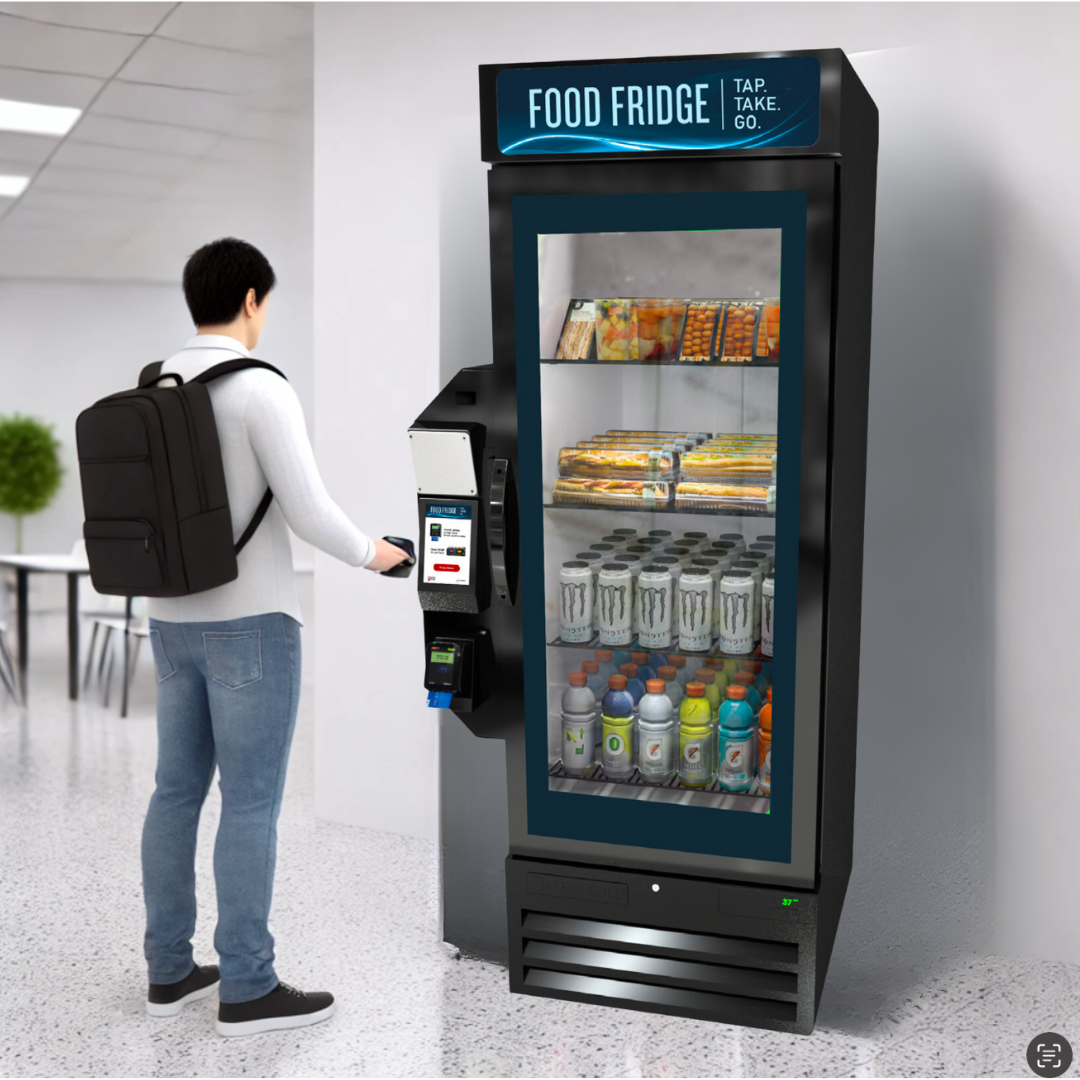 Some of the most significant growth in smart vending is fresh meal and perishable food programs—applications mechanical vending cannot reliably support.
Traditional vending limitations for fresh food:
- Coils damage packaging and presentation
- Drop mechanisms increase spoilage risk
- Manual inventory checks required for expiration tracking
- Limited product variety due to size/shape constraints
RFID advantages for fresh food:
- Gentle product handling (no mechanical dispensing)
- Real-time expiration tracking and automated markdown
- Precise inventory preventing stockouts and spoilage
- Flexible product sizing without mechanical constraints
REDYREF's Fresh Food Fridge uses RFID technology to support fresh meal programs in universities, hospitals, corporate offices, and manufacturing facilities—environments where traditional food service is unavailable or uneconomical but employees, students, patients, and visitors require 24/7 meal access.
RFID Vending Applications Beyond Food
While fresh food drives current market growth, RFID infrastructure supports diverse automated retail categories:
High-Value Electronics and Accessories
Airport retailers, transit hubs, and entertainment venues deploy RFID vending for phone chargers, headphones, portable batteries, and travel accessories where customers need immediate access and traditional retail faces prohibitive rent.
RFID provides loss prevention, inventory accountability, and real-time stock visibility that conventional dispensing cannot deliver for premium-priced items.
Pharmaceutical and Healthcare Products
Hospitals, clinics, workplace wellness programs, and senior living facilities use RFID dispensing for over-the-counter medications, first aid supplies, and health products requiring compliance tracking and controlled access.
RFID systems log every transaction by user, product, and timestamp—supporting audit requirements and inventory control that traditional systems lack.
Personal Protective Equipment (PPE)
Manufacturing facilities, construction sites, and industrial operations dispense safety glasses, gloves, respirators, and protective gear through RFID systems tracking usage by employee and department.
This enables cost allocation, compliance documentation, and automated reorder triggers based on consumption patterns.
Beauty and Personal Care
Premium cosmetics brands deploy RFID vending in malls, airports, hotels, and transit stations where self-service retail appeals to convenience-focused shoppers and traditional staffed counters are cost-prohibitive.
RFID supports loss prevention for high-theft categories while maintaining inventory accuracy.
RFID vs Traditional Vending: Key Advantages
Real-Time Inventory Intelligence: Cloud-connected RFID systems provide live product counts, expiration tracking, sales velocity analysis, and predictive restocking alerts—eliminating manual inventory checks and reducing stockouts.
Elimination of Dispensing Failures: No jams, stuck products, or dispensing errors. RFID removes physical mechanisms that degrade performance and require field service.
Flexible Product Sizing and Packaging: Items of varying dimensions fit within the same unit without coil configuration constraints, enabling diverse product assortments.
Item-Level Tracking and Accountability: Every product removed is logged with timestamp, user identification (when applicable), and transaction details—supporting loss prevention, compliance, and business intelligence.
Dynamic Pricing and Promotions: Individual items can be priced variably, marked down approaching expiration, or bundled for promotions without reprogramming.
Operator Business Models: Restaurants, caterers, food service companies, and specialty retailers use RFID vending to extend brand reach and create satellite revenue channels without opening brick-and-mortar locations.
RFID vs. Computer Vision: Technology Comparison
RFID is not the only item-level tracking technology available for smart vending. Computer vision systems using AI-powered cameras to identify products visually are emerging as alternatives.
RFID advantages:
- Proven reliability across diverse product types
- No lighting or camera angle dependencies
- Lower processing power requirements
- Established supply chain for tags and readers
Computer vision advantages:
- No physical tagging required
- Can identify untagged products
- Potentially lower per-unit operating costs at scale
RFID compared to AI camera technology presents tradeoffs in accuracy, cost structure, and operational complexity. RFID currently dominates commercial deployments due to proven track record and supply chain maturity.
Deployment Environments for RFID Vending
Corporate Offices
Companies implement fresh meal programs through RFID vending to provide employee food access without operating cafeterias, reducing overhead while maintaining workplace amenities that support retention.
Healthcare Facilities
Hospitals deploy RFID systems for 24/7 meal access serving overnight staff, patient families, and outpatient visitors when cafeterias are closed.
Universities and Campus Environments
Fresh food vending for universities addresses student meal needs during late-night study sessions, early mornings, and between dining hall operating hours.
Manufacturing and Industrial Sites
Plants operating multiple shifts use RFID vending to provide meal access for workers unable to leave facilities during breaks, supporting 24/7 operations without dedicated food service staff.
Hotels and Hospitality
Hotels offer guests grab-and-go meal options beyond traditional room service, while co-working spaces provide premium food access differentiating their amenities.
Micro Markets and Convenience Retail
RFID vending micro markets scale from single refrigerated units to multi-unit installations resembling unstaffed convenience stores, generating retail revenue in spaces unsuitable for traditional formats.
Technology Integration Requirements
Effective RFID vending requires integration across enterprise systems rather than standalone hardware deployment:
- Cloud Management Platforms: Centralized inventory monitoring, sales analytics, equipment diagnostics, and restocking optimization across distributed locations
- Payment Processing: Cashless transaction systems supporting credit/debit cards, mobile wallets, campus cards, and employee badge access with PCI compliance
- Inventory and Fulfillment: Predictive analytics for product mix optimization, automated reorder triggers, and route planning for distribution efficiency
- Temperature Monitoring and Compliance: Refrigeration systems with remote alerts ensuring food safety compliance, regulatory documentation, and equipment reliability
- Customer Interface: Touchscreen software with intuitive navigation, product filtering, nutritional information, allergen labeling, and accessibility features
- Network Connectivity and Security: Reliable internet access enabling real-time transaction processing, encrypted data transmission, and secure remote management
This infrastructure operates as an integrated system—requiring kiosk software functioning as middleware connecting customer interfaces to backend commerce and operational platforms.
Business Model Considerations
Organizations deploy RFID vending to address specific operational and revenue objectives:
- Labor Cost Reduction: 24/7 product access without staffing overnight shifts or low-traffic periods
- Real Estate Efficiency: Revenue generation in spaces too small or unprofitable for traditional retail
- Brand Extension: Established food businesses reach new locations and customer segments without opening storefronts
- Employee Benefits: Companies provide meal programs or convenience services differentiating workplace amenities
- Margin Optimization: Capture sales during hours when staffed service is unavailable or uneconomical
- Data-Driven Operations: Real-time visibility into purchasing patterns, inventory performance, and customer behavior
REDYREF's RFID Vending Solutions
REDYREF engineers RFID-enabled smart vending systems for high-traffic public and commercial environments, integrating commercial-grade hardware, enterprise software platforms, secure payment processing, and cloud-based management infrastructure to support multi-site deployments across distributed operations.
Our solutions are built for regulatory and compliance environments including food safety standards, pharmaceutical access controls, and industrial workplace requirements. From concept and engineering through deployment, systems integration, and long lifecycle hardware support, we work with operators, food service companies, facility managers, and retailers implementing solutions tailored to specific product categories, operational models, and enterprise scalability requirements.
RFID vending is not one-size-fits-all. Commercial deployments require proven integration capability with existing enterprise systems, compliance with industry-specific regulations, commercial-grade durability for public environments, and long-term technical support across multi-location operations.
The Future of RFID Vending
Several trends are shaping the evolution of RFID-enabled automated retail:
- Sustainability and Waste Reduction: Smart vending reducing food waste through precise inventory management, dynamic expiration-based pricing, and data-driven product selection
- Integration with Delivery and Ghost Kitchens: Unattended pickup lockers for delivery orders, meal dispensing from ghost kitchen operations, and hybrid models combining delivery with self-service access
- Expanded Product Categories: Fresh flowers, local artisan products, restaurant partnership meals, and specialty items previously requiring staffed retail
- Personalization and Loyalty Integration: Purchase history recommendations, customized pricing, and loyalty program integration within self-service interfaces
- Non-Traditional Locations: Apartment buildings, residential complexes, transit stations, and community spaces becoming micro-retail endpoints
Frequently Asked Questions
What is RFID vending?
RFID vending uses radio-frequency identification technology to track individual products in automated dispensing systems. Unlike coil-based systems, RFID identifies items when removed, processes payment automatically, and updates inventory in real time.
How does RFID vending work?
Each product carries an RFID tag containing a microchip and antenna. When customers remove items, RFID readers integrated into the kiosk identify the product, process payment, and update cloud-based inventory systems—all without mechanical dispensing.
What products work in RFID vending machines?
Fresh and prepared foods, beverages, pharmaceuticals, electronics, cosmetics, PPE, health products, and any merchandise suitable for self-service purchase with appropriate environmental controls. RFID enables product categories that traditional systems cannot reliably support.
Why is RFID better than traditional vending?
RFID eliminates jams and failures, provides real-time inventory tracking, supports diverse product sizes without coil constraints, enables dynamic pricing, and delivers item-level accountability that conventional systems lack.
Can RFID vending support fresh food?
Yes. RFID is the primary technology enabling fresh meal vending programs. Real-time expiration tracking, gentle product handling, and precise inventory management make RFID ideal for perishable foods.
What's the difference between RFID and computer vision vending?
RFID uses physical tags on products for identification. Computer vision uses AI-powered cameras to identify items visually. RFID offers proven reliability and established supply chains; computer vision eliminates tagging but requires more sophisticated processing.
Where are RFID vending machines typically deployed?
Corporate offices, hospitals, universities, manufacturing facilities, hotels, co-working spaces, transit hubs, and locations requiring 24/7 product access without staffing or where traditional retail is impractical.
How does RFID vending reduce operational costs?
RFID automates inventory tracking, eliminates manual stock checks, reduces spoilage through expiration monitoring, prevents theft with item-level accountability, and enables predictive restocking—reducing labor costs and improving margins.
RFID-enabled vending is not an incremental upgrade to traditional machines—it is infrastructure enabling automated retail categories, business models, and deployment environments that conventional systems cannot support.