The smart vending industry offers businesses two distinct technology paths: AI camera-based product recognition and RFID-enabled inventory tracking. Both power successful operations, but they solve different problems and align with different business priorities. Understanding which technology fits your self-service vending operation requires looking beyond upfront costs to consider accuracy requirements, inventory complexity, and operational priorities.
How the Technologies Work
AI Camera-Based Recognition
Computer vision systems use cameras and machine learning to identify products as customers remove them. Operators photograph each product during setup, and the AI learns to recognize items visually. These systems report accuracy around 99%, with notifications when the system encounters uncertainty.
Camera-based vending works adequately for shelf-stable products and stable assortments. However, the technology cannot track expiration dates at the item level—a critical limitation for fresh food operations.
RFID-Enabled Tracking
RFID technology takes a fundamentally different approach. Each product carries an RFID tag containing digital information—product identity, price, and crucially, expiration date data. When customers complete payment and open the unit, RFID readers detect which tagged items are removed and process the transaction.
RFID provides deterministic tracking—tags are either read or they aren't, with no interpretation required. This creates complete inventory visibility regardless of how products are arranged, lit, or displayed inside the vending unit.
The Cost Structure Difference
Understanding the cost implications requires looking beyond initial investment to ongoing operational expenses.
AI Camera Systems operate on a front-loaded cost model with no per-item consumable costs. Ongoing expenses are typically $150–$250 monthly for connectivity and platform fees.
RFID Systems combine hardware investment with ongoing consumable costs. While the Smart Food Fridge hardware starts at $7,500, RFID tags add $0.18 per unit. Combined with REDYREF’s $199/month platform fee (covering cellular connectivity, cloud analytics, and technical support), a high-turnover machine restocking 200 units weekly adds roughly $1,872 annually in tag costs.
This cost difference matters less than what each technology enables. For meal vending operations where waste reduction, food safety, and inventory accuracy are paramount, RFID’s capabilities justify the incremental investment.
The Expiration Date Management Challenge
 Fresh food vending introduces complexity that separates these technologies most clearly.
AI camera systems excel at product identification but struggle with time-sensitive inventory management. The system knows a sandwich was removed, but tracking when that sandwich expires requires manual backend processes or additional inventory management systems.
RFID systems embed expiration data directly into product tags. This enables automated freshness tracking that fundamentally changes how operators manage perishable inventory:
- Real-time alerts when products approach expiration dates
- Automated removal of expired items from available inventory
- Dynamic pricing to discount near-expiration items
- Data showing which products sell quickly versus which risk spoilage
- Documentation supporting food safety compliance
For fresh food operations—particularly in healthcare facilities, corporate cafeterias, or catering services—this capability directly impacts both food safety and profitability. Smart vending technology that reduces waste by 60–75% compared to traditional vending often justifies the additional tag costs through avoided spoilage alone.
Accuracy and Operational Reliability
AI camera systems achieve 99% accuracy under ideal conditions but struggle with similar packaging, lighting variation, and multiple-item removal.
RFID systems provide deterministic accuracy—tags are either detected or they aren’t. This reliability is critical in meal vending operations where inventory accuracy and food safety documentation are non-negotiable.
Why Meal Vending Operations Choose RFID
 If you're operating or planning a fresh meal vending business, RFID technology addresses challenges that camera-based systems can’t solve.
Expiration Management Is Non-Negotiable
RFID tracks expiration dates at the item level, alerts operators before spoilage, and documents compliance—capabilities required for professional food service.
Waste Reduction Directly Impacts Profitability
Smart vending technology that reduces food waste by 60–75% transforms unit economics. RFID enables this through precise expiration tracking and dynamic pricing.
Data Drives Menu Optimization
RFID provides granular data on every transaction—what sells, what spoils, and how behavior varies by location and time.
Professional Operations Require Audit Trails
RFID provides complete documentation showing when items entered inventory, when they sold, and how freshness was maintained—supporting regulated food environments.
When Camera Technology Makes Sense
Camera-based vending works well for beverages, shelf-stable snacks, and convenience items where expiration tracking isn’t critical.
What This Means for Fresh Food Vending Operations
If you're a caterer, food service provider, or operator focused on prepared meals, RFID isn’t just better—it’s the professional standard.
REDYREF’s Smart Food Fridge: Built for Meal Vending
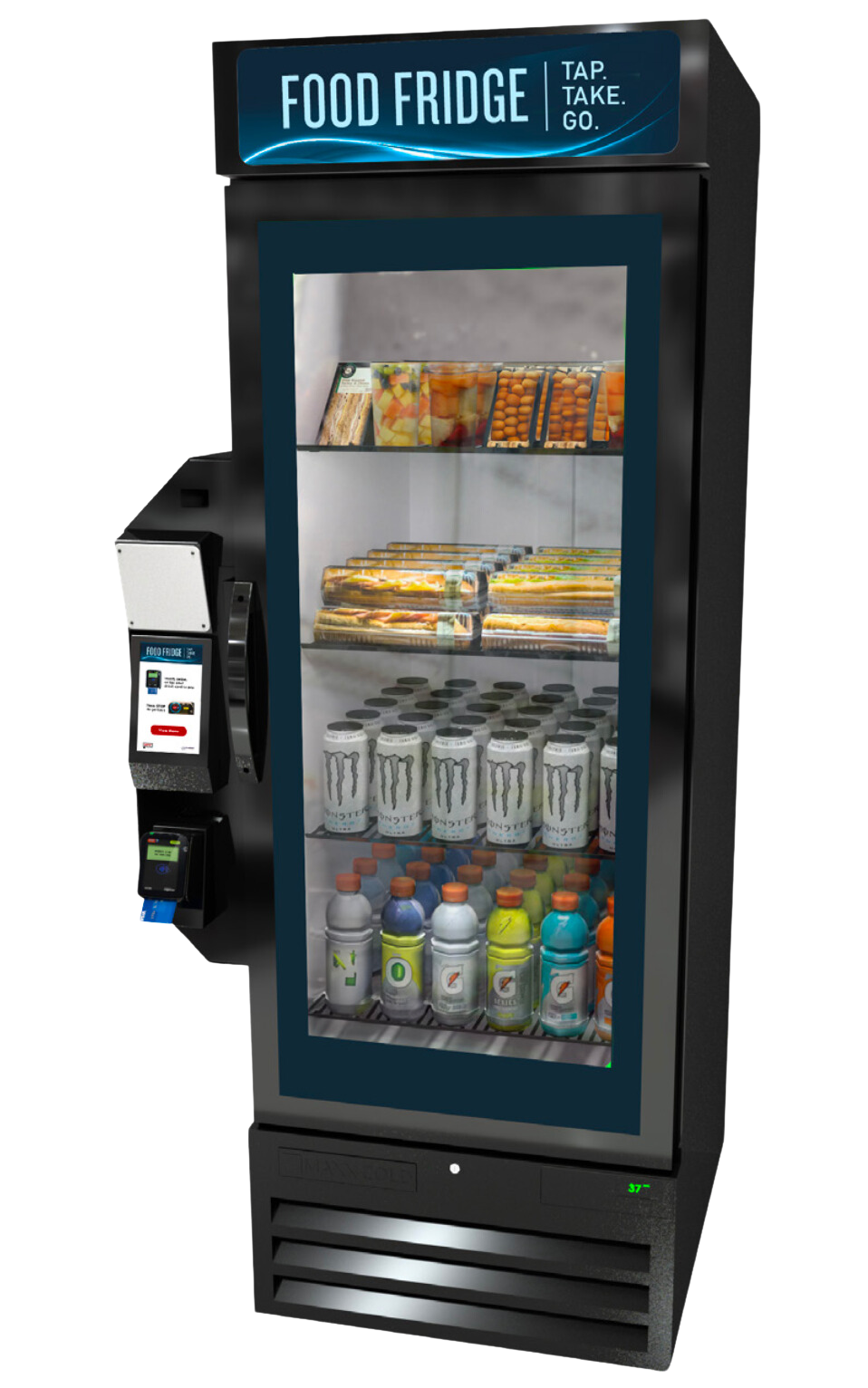
REDYREF’s Smart Food Fridge uses RFID technology because we focus exclusively on fresh food and prepared meal vending.
- $7,500 Smart Fridge hardware; Smart Freezer available for $8000 (1-year warranty)
- $199/month platform services
- $0.18 per tag RFID tracking
- Financing available under $300/month
Operating a fresh food or meal vending business?
Contact REDYREF to discuss how RFID-enabled smart vending supports your operation.
AI Camera vs. RFID Smart Vending FAQ
What’s the difference between AI camera vending and RFID smart vending?
AI camera systems use computer vision to identify products visually when customers remove items. RFID systems use tags on each item, and readers detect exactly which tagged products were removed—no visual interpretation required.
Which smart vending technology is best for fresh meals and perishable food?
RFID is typically the better fit for fresh meal vending because it can track expiration dates at the item level, enable real-time freshness alerts, and support automated removal or discounting of near-expiration items.
Can AI camera-based vending track expiration dates per item?
Not reliably. Camera systems can identify that a product was removed, but they don’t inherently track item-level expiration dates. Expiration tracking usually requires manual processes or a separate inventory system.
How accurate are AI camera systems compared to RFID?
AI camera systems often report accuracy around 99% under ideal conditions, but performance can degrade with similar packaging, lighting variation, or multiple-item removal. RFID is deterministic: tags are either detected or they aren’t, which is why it’s often preferred when inventory accuracy is non-negotiable.
What are the ongoing costs for RFID smart vending?
RFID systems combine hardware investment with ongoing consumable tag costs. REDYREF’s Smart Food Fridge hardware starts at $7,500, RFID tags add $0.18 per unit, and the platform fee is $199/month (covering cellular connectivity, cloud analytics, and technical support). For a high-turnover machine restocking 200 units weekly, tag costs add roughly $1,872 annually.
When does camera-based vending make more sense?
Camera-based vending is often a good fit for beverages, shelf-stable snacks, and convenience items where item-level expiration tracking isn’t critical.