Cashless operations make transactions faster, cleaner, and easier to manage. But for many businesses, going cashless creates a practical problem: what happens when a customer only has cash?
That question matters more now than it used to. Some businesses want to reduce cash handling because it slows down checkout, increases reconciliation work, creates shrink risk, or complicates staffing. Others need a cash acceptance strategy because local or state regulations require them to serve cash-paying customers. Either way, a cash-to-card kiosk gives operators a way to accept cash without handling it at every register, concession stand, service counter, or point of sale.
A cash-to-card kiosk—also called a reverse ATM—allows customers to insert cash and receive a prepaid card loaded with the same value. The customer can then use that card within the venue, store, campus, or other payment environment. For businesses, the result is a more controlled cash workflow that supports cashless operations without excluding customers who rely on cash.
For operators evaluating whether this model makes sense, the real question isn't simply "What is a reverse ATM?" It's whether a cash-to-card kiosk can reduce operational friction, support compliance, improve payment flow, and justify its total cost over time.
What is a cash-to-card kiosk?
A cash-to-card kiosk is a self-service machine that converts physical cash into prepaid card value. The customer inserts bills, follows the on-screen prompts, and receives a card that works like any digital payment method.
The term "reverse ATM" gets used because the process works in the opposite direction of a traditional ATM. Instead of withdrawing cash from a bank account, the customer deposits cash and receives a usable payment card. REDYREF's guide to what a reverse ATM is explains this in more depth, but the core idea is simple: the kiosk turns cash into a payment method that works in a cashless environment.
For businesses, this changes where cash gets handled. Instead of accepting bills at every point of sale, cash flows through a centralized kiosk. That makes day-to-day operations easier to manage, especially in locations with high transaction volume, multiple registers, temporary staff, or limited tolerance for cash-handling errors.
How do reverse ATMs work?
Most reverse ATM deployments follow a straightforward customer workflow:
- The customer approaches the kiosk and selects the cash-to-card option.
- The customer inserts cash into the bill acceptor.
- The kiosk validates the cash and displays the loaded amount.
- The system issues or reloads a prepaid card.
- The customer uses the card for purchases within the business, venue, or broader payment network, depending on configuration.
Behind that simple user experience is kiosk hardware, payment software, card issuing, transaction processing, and administrative reporting. The exact configuration depends on the operator's needs. A stadium might need several high-capacity units placed near entrances and concession areas, while a retail location might only need one compact unit positioned near checkout or customer service.
REDYREF's cash-to-card kiosk solutions are designed around that full deployment model—combining hardware, software, transaction processing, and support rather than treating the kiosk as a standalone machine.
Why do businesses use cash-to-card kiosks?
Businesses use cash-to-card kiosks because they want the operational benefits of cashless payments without turning away cash-paying customers.
Cash is expensive to manage. It requires staff training, drawer balancing, manager approvals, secure storage, deposits, armored pickup in some environments, and ongoing reconciliation. In busy venues or distributed retail environments, even small cash-handling issues create delays, accounting problems, or loss exposure.
A reverse ATM shifts cash acceptance into a more controlled process. Instead of every cashier or employee handling cash, customers convert their cash at a self-service kiosk and pay digitally. That helps businesses:
- Reduce cash handling at registers and service counters
- Improve transaction speed in high-volume areas
- Simplify reconciliation and reporting
- Reduce shrink and cash security concerns
- Support customers who don't have credit cards, debit cards, or mobile wallets
- Maintain a more consistent cashless payment experience
- Support compliance in jurisdictions with cash acceptance requirements
This matters most in environments where lines, staffing pressure, and guest experience are all connected. Stadiums, amusement parks, festivals, transportation hubs, campuses, hospitality venues, and large retail locations all need payment systems that keep people moving without excluding cash-paying customers.
Are cash-to-card kiosks only for cashless businesses?
No. Cash-to-card kiosks are often used by cashless businesses, but they help any business that wants to reduce cash handling.
Some operators deploy reverse ATMs because they're fully cashless or moving in that direction. Others still accept cash in some parts of their business but want to reduce how often employees handle it. A venue might use a kiosk to convert cash before customers reach food, beverage, merchandise, or ticketing areas. A retail operation might use one unit near the front of the store to reduce cash at individual registers.
That flexibility matters. A cash-to-card kiosk doesn't have to replace every existing payment process on day one. It can be part of a broader self-service strategy that moves cash out of high-friction areas and into a more secure, automated workflow.
Do reverse ATMs help with cash acceptance laws?
Yes. In some jurisdictions, a properly configured cash-to-card kiosk helps businesses accommodate cash-paying customers while maintaining a cashless point-of-sale environment.
This matters because cash acceptance rules are becoming more important for retailers, venues, restaurants, and other customer-facing businesses. REDYREF's article on New York's cash acceptance law, S4153A, explains that New York's law includes an exception for on-site cash-to-card conversion devices when specific requirements are met—including no fees, deposits as low as $1, receipts, and funds that don't expire.
That doesn't mean every kiosk automatically satisfies every legal requirement. Compliance depends on location, fee structure, card program, customer workflow, receipt handling, expiration policies, and other details. Businesses should evaluate local requirements carefully and work with a provider that understands how reverse ATM deployments need to be configured for real-world operations.
For operators in cash-mandate markets, the key benefit is practical: customers can still use cash, but staff don't have to handle cash at every point of sale.
What types of businesses use cash-to-card kiosks?
Cash-to-card kiosks are most useful where cash creates friction, risk, or inconsistency at scale. Common deployment environments include:
Sports stadiums and arenas. Large venues need fast-moving payment lines at concessions, merchandise stands, parking areas, and ticketing locations. Reverse ATMs help cash-paying guests participate in a cashless venue experience without slowing down individual sales points.
Amusement parks, carnivals, and festivals. Temporary and seasonal environments often involve multiple vendors, outdoor conditions, mobile setups, and high guest volume. A cash-to-card kiosk centralizes cash conversion and reduces the burden of managing physical cash across many payment locations.
Retail stores. Retailers in cash-mandate areas need a way to serve cash-paying customers without adding cash handling back into every register lane. A kiosk supports compliance while preserving a more streamlined payment experience.
Transportation hubs. Airports, transit stations, and other mobility environments serve travelers with different payment preferences, banking access, and currency habits. Cash-to-card systems help move those users into a digital payment workflow.
College campuses and institutional environments. Campuses use cash-to-card kiosks to support dining, bookstore, event, laundry, recreation, or service payments while reducing cash handling across departments.
Hospitality and entertainment venues. Hotels, casinos, concert venues, and entertainment properties use reverse ATMs to simplify payment access for guests while supporting a more consistent cashless environment.
REDYREF's business and venue operator FAQ covers additional use cases, cost considerations, compliance questions, and deployment planning for organizations evaluating this solution.
Where REDYREF Cash-to-Card Kiosks Are Used
REDYREF cash-to-card kiosks have been deployed in high-traffic entertainment, hospitality, and family recreation environments where operators need to support cash-paying guests without slowing down cashless payment workflows.
The Sphere — Las Vegas

REDYREF cash-to-card kiosks support cashless guest transactions in one of the country's most recognizable entertainment venues. In an environment built around high-volume events, reverse ATMs give cash-paying guests a practical way to participate in digital payment systems without requiring staff to handle cash at every point of sale.
Hard Rock Hotel — New York City
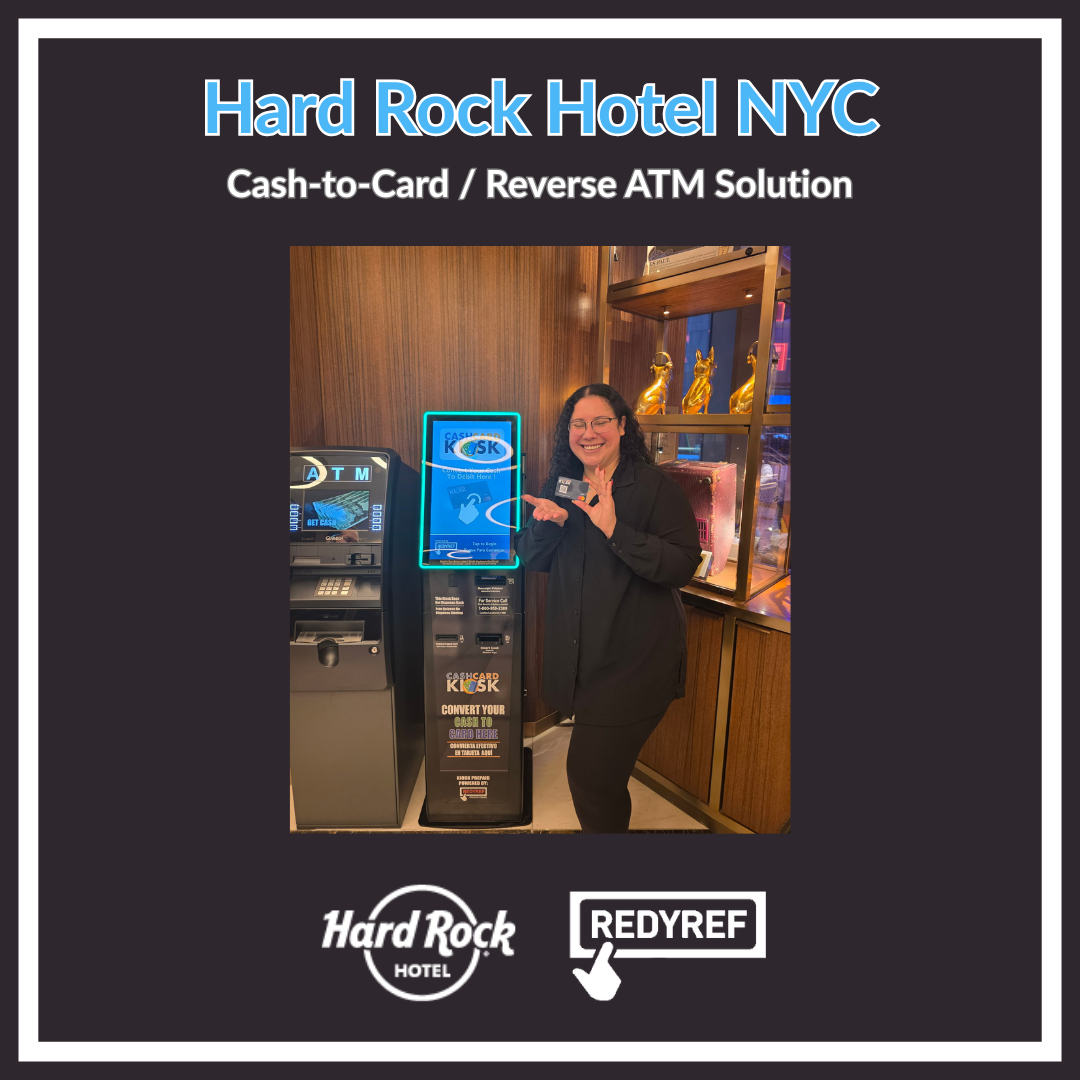
At Hard Rock Hotel New York, REDYREF kiosks help support cash-to-card conversion in a hospitality environment where guest convenience, payment flexibility, and operational consistency all matter. The deployment reflects how reverse ATMs can fit into hotel and entertainment properties that want to reduce cash friction while maintaining service access.
Kids Empire Entertainment Centers

Kids Empire uses REDYREF cash-to-card kiosks in a family entertainment setting, where guests may need payment access for attractions, food service, merchandise, or other on-site purchases. For multi-location entertainment businesses, centralized cash conversion can make it easier to support cash-paying customers while reducing cash handling across the operation.
These deployments show how cash-to-card kiosks can support very different operating environments, from major entertainment venues to hospitality properties and family recreation centers. For businesses evaluating a similar rollout, the important question is not whether reverse ATMs work in theory, but how the kiosk should be configured for the location, traffic pattern, payment workflow, and customer experience.
What should businesses consider before deploying a reverse ATM?
A successful reverse ATM deployment depends on more than buying a machine. Operators need to think through placement, transaction volume, customer behavior, compliance, support, and how the kiosk connects to the rest of the payment environment.
The most important planning questions include:
Where should the kiosk be placed? The best location is visible, intuitive, and close to the point of need. In a stadium, that might mean entrances, concession zones, or high-traffic concourses. In a retail store, it might mean near checkout or customer service. If customers can't find the kiosk easily, usage suffers.
How many kiosks are needed? This depends on foot traffic, expected cash volume, peak transaction windows, and facility size. One kiosk might be enough for a smaller retail environment, while a large venue might need multiple units to avoid bottlenecks.
What card and fee structure will be used? Some deployments charge transaction fees, while compliance-driven deployments may need to avoid fees entirely. The right model depends on the legal environment, customer expectations, and the operator's business goals.
What are the connectivity and power requirements? Like other transactional kiosks, reverse ATMs require reliable power, network connectivity, secure processing, and physical placement that supports accessibility and service access.
Who handles support and maintenance? Operators should understand who's responsible for servicing the kiosk, managing cash collection, supporting software updates, troubleshooting issues, and training staff.
How will customers know what to do? Even a simple kiosk needs clear signage and staff awareness. When employees understand the workflow, they can quickly direct cash-paying customers to the kiosk instead of creating confusion at the point of sale.
REDYREF's cash-to-card implementation guide is a useful resource for businesses that want to understand deployment requirements in more detail.
What does a cash-to-card kiosk cost?
Cash-to-card kiosk pricing depends on hardware configuration, number of units, transaction model, card program, software requirements, installation needs, and support arrangement.
For most businesses, the better question isn't "What does the kiosk cost?" but "How does the kiosk compare to the cost of handling cash today?" Cash management costs include labor, reconciliation time, manager oversight, armored transport, bank fees, supplies, shrink, reporting complexity, and slower transaction flow. These costs aren't always obvious because they're spread across departments and workflows.
That's why an ROI model helps. A small retail location, a major venue, and a seasonal event operator won't evaluate the investment the same way. REDYREF's cash-to-card kiosk FAQ for businesses includes an ROI calculator that helps operators think through their own numbers instead of relying on generic assumptions.
What makes REDYREF different?
REDYREF supports cash-to-card and reverse ATM deployments as part of a broader self-service kiosk strategy. That matters because the kiosk itself is only one piece of the project.
A reliable deployment requires hardware selection, enclosure design, payment configuration, software integration, card program coordination, installation planning, signage, support, and long-term service. REDYREF works across those layers, helping businesses choose a kiosk model and deployment approach that fits the actual environment where it will be used.
A compact indoor unit might work well for a retail location with limited floor space. A larger freestanding model might make more sense for a high-traffic venue. Outdoor, temporary, or event-based deployments may require additional durability, visibility, mobility, or environmental considerations. REDYREF's cash-to-card kiosk solutions page outlines several hardware configurations and use cases for different operating environments.
Just as important, REDYREF isn't only a hardware provider. The company also supports kiosk software, custom kiosk manufacturing, payment-related workflows, and integrated self-service systems across multiple industries. That gives operators a single partner for planning, deployment, and long-term support instead of coordinating disconnected vendors.
How should businesses get started?
The best first step is defining the problem the kiosk needs to solve.
For some businesses, the goal is compliance. For others, it's reducing cash handling. For high-volume venues, it might be improving transaction speed and guest flow. For seasonal or event-based operators, it might be simplifying vendor payment operations. The right deployment depends on the business case.
Before requesting a quote, operators should gather a few details:
- Current cash transaction volume
- Number of locations or payment zones
- Peak traffic periods
- Whether cash acceptance laws apply
- Indoor, outdoor, or mobile deployment requirements
- Desired card and fee structure
- Existing POS or payment environment
- Support and maintenance expectations
From there, REDYREF can help evaluate whether a cash-to-card kiosk is a good fit, what type of configuration makes sense, and how the deployment should be structured.
Businesses comparing options can start with REDYREF's cash-to-card and reverse ATM FAQ, review the cash-to-card kiosk solutions page, or contact REDYREF to discuss a specific deployment.
The bottom line
Cash-to-card kiosks aren't just a convenience feature. For many businesses, they're part of a larger operational shift: reducing cash handling, supporting digital payments, improving transaction flow, and serving cash-paying customers without rebuilding the entire payment environment around cash. A reverse ATM gives customers a simple way to convert cash into a usable payment card. For operators, it centralizes cash acceptance into a controlled, self-service process. That makes cashless operations easier to manage, especially in high-traffic environments where speed, consistency, and compliance all matter.
For businesses exploring cashless operations, responding to cash acceptance requirements, or looking for a more efficient way to handle cash-paying customers, REDYREF can help evaluate the right kiosk configuration and deployment model. Book a 15-minute consultation or request a quote to get started.x