Food waste represents one of the most pressing sustainability challenges facing modern society. According to the Food and Agriculture Organization (FAO), approximately one-third of all food produced for human consumption—roughly 1.3 billion tons annually—is lost or wasted. This squanders the resources invested in production (water, energy, labor, agricultural inputs) and contributes significantly to climate change: global food loss and waste are responsible for an estimated 8–10% of annual greenhouse gas emissions.
The vending industry has historically contributed to this problem through inefficient inventory management, poor demand forecasting, and limited ability to track product freshness accurately. Smart vending technology—particularly refrigerated, RFID-enabled systems—now offers practical ways to reduce food waste while improving operator profitability. The environmental imperative aligns with compelling business benefits: when operators waste less inventory, they typically see higher net profit per transaction.
The Scale of Food Waste in Automated Retail
Traditional vending operations that sell fresh or short-shelf-life items often see low double-digit waste rates for perishable products, especially when inventory is managed manually. While exact numbers vary by operator, this is generally much higher than:
- Grocery retail, where supermarkets throw away the equivalent of about 2.5–4% of potential revenue in surplus food.
- Restaurant foodservice, where kitchens typically waste 4–10% of the food they purchase before it reaches the plate.
Several structural issues drive these elevated waste levels in traditional vending:
Poor visibility: Traditional machines provide minimal real-time inventory data. Service technicians discover spoilage only during service visits, by which time multiple products may have expired.
Overstocking: Without accurate consumption data, route managers overstock to avoid running out of popular items, which inevitably leads to expired inventory.
Manual tracking: Handwritten or basic digital logs for expiration dates are unreliable at scale across many machines and locations.
FIFO challenges: It is difficult to maintain proper first-in, first-out (FIFO) rotation; older products can get "buried" behind newer stock and expire unsold.
Limited product information: Customers rarely see clear date labels or freshness information at the point of purchase, so products that are still safe but near their date often get passed over.
These automated, self-service systems address each of these systemic challenges through embedded technology and data-driven operations.
How Smart Vending Reduces Food Waste
Real-Time Inventory Tracking and Expiration Management
 RFID technology enables item-level inventory tracking with expiration-date awareness. Systems maintain continuous visibility into every product's age and remaining shelf life. Route managers receive automated alerts as products approach their "sell by" or "use by" dates, enabling:
- Proactive removal of items nearing expiration during scheduled service visits.
- Dynamic discount pricing on near-date items to accelerate sell-through.
- Donation coordination, where products pulled before expiration can be redirected to food recovery organizations.
Real-world RFID deployments in grocery and food environments have shown meaningful double-digit reductions in food waste (for example, a regional grocery chain reported a 28% reduction in waste after implementing RFID-based expiry tracking). RFID-enabled vending applies the same principles to unattended fresh-food retail, using item-level data to keep products moving before they expire.
Optimized Stock Rotation
RFID-enabled machines can effectively enforce FEFO (first expired, first out) rather than "whatever's in front." When multiple units of the same product are present, the system can:
- Prioritize dispenses from the units closest to expiration.
- Highlight near-date items on a touchscreen with visual cues or discounts.
Integrating RFID with FEFO logic has been shown to significantly reduce waste from expired products in other food-supply-chain contexts, and the same logic applies in vending.
Data-Driven Demand Forecasting
Machine learning models can analyze historical sales and contextual factors to predict demand more accurately:
- Time-of-day, day-of-week, and seasonal patterns
- Location-specific behavior (office vs hospital vs university, nearby food options, demographics)
- Product-level performance and preferences
- External signals like weather, events, or holidays
In grocery and retail, advanced analytics used for forecasting and shrink reduction are already proven to lower overstock and food waste while maintaining availability. Modern vending uses similar models to generate data-backed stocking recommendations, replacing guesswork with evidence.
Intelligent Reordering and Par-Level Management
Modern smart vending platforms automatically calculate par levels—the optimal quantity of each product to hold between service visits—based on predicted sales and service frequency. As patterns change, par levels adjust without manual intervention.
When inventory drops below minimum thresholds, the system can trigger reorders directly with suppliers or commissary kitchens, enabling more just-in-time production and stocking. This keeps inventory fresher and reduces the risk of both overstock and product unavailability.
Advanced Temperature Control and Monitoring
Refrigerated smart vending systems maintain precise, continuously monitored temperature zones tailored to different product types (e.g., dairy, fresh meals, beverages, frozen items). When sensors detect a temperature excursion (e.g., compressor failure, door left open), service teams receive real-time alerts and can respond before an entire machine of inventory is compromised.
IoT-enabled refrigeration and temperature monitoring have been shown to cut waste and protect quality in multiple food-industry case studies by preventing spoilage events that previously went unnoticed.
Consumer Education and Transparency
Touchscreen displays can present richer product information than a traditional machine:
- Clear expiration or "best by" dates
- Ingredients and nutrition information
- Sourcing and sustainability details (e.g., local producers, certifications)
- Clarification of "sell by" vs "use by" vs "best before," which consumers often misinterpret
Dynamic pricing interfaces that show discounts on near-date products, combined with education around safety and quality, have been shown in grocery trials to significantly increase sales of soon-to-expire items and reduce waste.
In vending, similar transparency helps customers feel confident buying discounted, near-date items instead of avoiding them.
The Business Case: How Waste Reduction Improves Profitability
Food waste directly erodes vending profitability. Every expired item represents sunk product cost, handling labor, and disposal expense—and often a missed opportunity to sell something the customer wanted.
Direct Cost Savings
Inventory losses avoided
Imagine a typical fresh-food vending machine holding about $800–$1,200 of inventory at any given time. In a traditional model with a ~15% waste rate on perishable items, a vending business may effectively lose low-hundreds of dollars per machine per month in product that never sells. Over a year, that becomes a material cost line per machine.
RFID-enabled systems that bring waste down into the low-single-digit range (for example, 3–5%) can recover most of that loss. Across a fleet of dozens of machines, the avoided write-offs add up to tens of thousands of dollars annually. (Exact figures will vary by menu, pricing, and traffic patterns; the key is that every percentage point of waste reduction goes straight to the bottom line.)
Lower disposal and handling costs
Disposing of spoiled food carries:
- Direct costs: hauling, landfill or organics pickup fees
- Indirect costs: labor for pulling expired items, storage of waste, cleaning
Reducing waste by even a few percentage points across a network can decrease disposal tonnage and associated costs by double-digit percentages, especially when combined with donations or diversion to composting or anaerobic digestion.
More efficient restocking labor
Data-driven stocking means fewer unnecessary removals and "clean-out" visits. Technicians spend less time handling waste and more time on productive tasks (stocking, cleaning, minor maintenance), which improves route efficiency and capacity.
Revenue Enhancement
Improved product availability
When demand forecasting and par-level management work together, popular items stay in stock more reliably. In grocery and retail, reducing stockouts is directly tied to higher sales and customer satisfaction; the same effect applies to vending.
Even modest improvements in availability can drive mid-single- to low-double-digit gains in sales per machine, simply because customers aren't walking away empty-handed.
Expanded product selection and higher margin items
With stronger inventory control and reduced waste risk, vending businesses can confidently offer:
- Shorter-shelf-life items (e.g., fresh salads, prepared meals)
- Premium SKUs (higher price point, higher margin)
- Seasonal or limited-time offerings
Traditional vending often avoids these categories due to spoilage concerns. RFID technology effectively "unlocks" them, increasing average transaction value and overall margin.
Dynamic pricing and revenue recovery
By automatically discounting items as they approach their date, RFID systems recover value that would otherwise be lost entirely. Grocery studies on dynamic pricing for perishables have found waste reductions on the order of ~20% while maintaining or even improving gross margins.
In an RFID vending context, even partial recovery of near-date inventory can meaningfully improve profitability.
Illustrative ROI Example
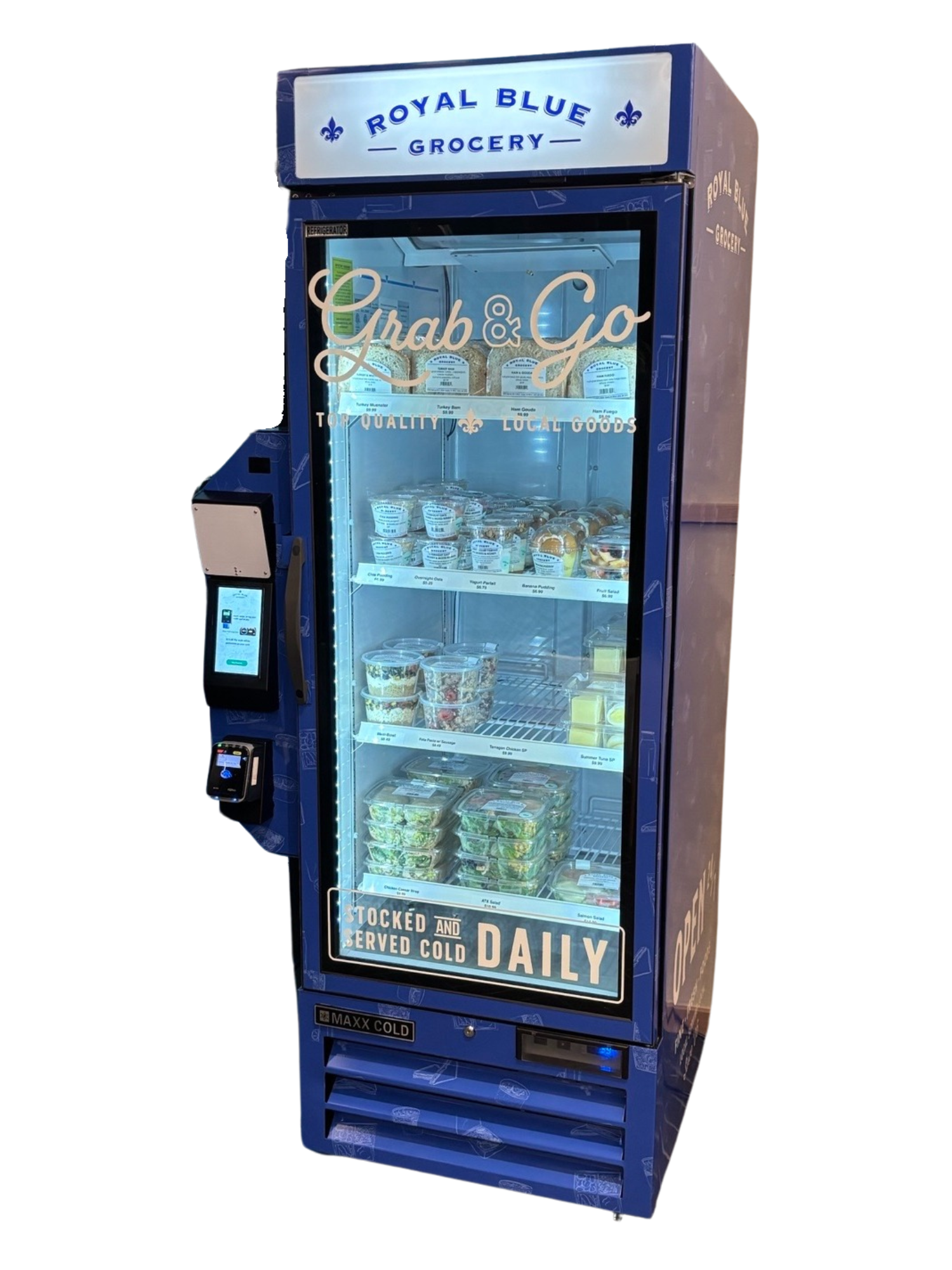 While equipment costs vary by configuration (REDYREF's Smart Food Fridge starts at $7,500 with $75/month technology fees), here's how the economics might work for a larger deployment:
Consider a hypothetical 50-machine fresh-food vending operation:
- Average inventory per machine: $1,000
- Total inventory deployed at any given time: $50,000
Traditional vending – annualized, simplified
- Food waste rate: 15%
- Annual waste loss (inventory cost): $7,500
- Disposal costs: $9,000 (50 machines × $15/month × 12)
- Missed sales from stockouts/poor assortment: $24,000 (illustrative estimate)
- Total negative impact: approximately $40,500 per year
RFID vending scenario – annualized, simplified
- Food waste rate: 4%
- Annual waste loss: $2,000
- Disposal costs: $2,700 (assumes ~70% reduction in wasted volume)
- Missed sales from stockouts: $6,000 (assumes 75% improvement)
- Increased sales (better availability & product mix): +$36,000 (≈12% uplift on a $300,000 revenue base, as an example)
Net improvement (illustrative)
- Waste reduction: +$5,500
- Disposal reduction: +$6,300
- Reduced missed sales: +$18,000
- Incremental sales: +$36,000
- Total improvement vs. traditional: about $65,800 per year based on these assumptions.
If the RFID vending upgrade requires $150,000 in capital and $12,000/year in software and connectivity, this simplified example yields a payback period on the order of two to three years, with ongoing annual benefits thereafter. Actual ROI will depend on menu, pricing, utilization, and financing, but the structure of the business case is robust: less waste + better availability + higher-value product mix = higher profits.
Implementation Best Practices
Organizations deploying RFID vending to reduce food waste can improve outcomes by:
Starting with high-waste locations
Pilot in sites with historically high spoilage or poor sell-through; early wins build internal support.
Establishing baseline metrics
Measure current waste rates, out-of-stock incidents, and route economics before implementation to quantify improvements.
Training service personnel
Ensure route drivers and technicians know how to read dashboards, interpret alerts, and make stocking decisions based on data-driven insights—not habit.
Partnering with food recovery organizations
Establish relationships with local food banks and recovery groups to accept safe, near-date products removed from machines before expiration.
Communicating sustainability performance
Share waste-reduction results with building owners, employees, or students; sustainability achievements increasingly matter to tenants, customers, and staff.
Continuously optimizing product mix
Use performance data to retire poor performers and test new items quarterly, keeping assortments aligned with actual demand.
Environmental Impact Beyond Operations
 Reducing food waste in automated retail has ripple effects beyond an individual business's P&L:
Resource conservation
Every pound of food not wasted preserves the water, land, energy, and inputs used to produce it. Global analyses show that food loss and waste collectively generate 8–10% of global greenhouse gas emissions, making it one of the most impactful levers for climate action in the food system.
Landfill diversion and methane reduction
When organic waste decomposes anaerobically in landfills, it emits methane, a greenhouse gas far more potent than CO₂ over a 100-year period. Preventing food from reaching landfills—or diverting it to donation, composting, or energy recovery—meaningfully reduces this impact.
Supply-chain efficiency
Demand signals from smart vending—what sells, where, and when—help suppliers better align production to actual consumption, reducing overproduction upstream.
The Future of Waste Reduction in Smart Vending
Emerging technologies will continue to push waste and shrink down:
- AI-enhanced forecasting that ingests external data (weather, events, calendar rhythms) to further refine demand predictions.
- Blockchain and traceability tools providing farm-to-fridge transparency for products, including age and handling history.
- Behavioral nudging in user interfaces to encourage selection of near-date products via messaging, placement, and incentives.
- Closed-loop and reusable packaging integrated with smart vending, potentially with deposit-return systems to reduce both food and packaging waste.
Alignment of Environmental and Business Priorities
Smart vending machines transform food-waste reduction from a vague sustainability aspiration into a measurable, operational KPI. The same technologies that reduce environmental impact—RFID tracking, real-time telemetry, analytics, and dynamic pricing—also improve profitability by lowering inventory losses, optimizing labor, and increasing sales.
For organizations evaluating vending solutions, waste-reduction capabilities are now a strategic differentiator. In an era when grocery and restaurant sectors are working aggressively to cut shrink, traditional fresh-food vending with high, opaque waste rates is increasingly out of step with stakeholder expectations and available technology. Smart systems that can push waste into the low single digits offer both environmental leadership and compelling financial returns.
REDYREF's Smart Food Fridge uses $0.18 RFID tags and a $199/month platform to deliver item-level tracking, predictive analytics, and advanced temperature monitoring at an accessible price point designed for operators of all sizes—from single-location pilots to multi-site deployments. Contact REDYREF to discuss how our smart vending solutions can help reduce waste and improve profitability in your operation.
Selected Sources
Food and Agriculture Organization of the United Nations (FAO). Global Food Losses and Food Waste. Rome: FAO; 2011.
United Nations Environment Programme; UNFCCC; US EPA. Food Loss and Waste and Climate Change. 2024–2025. Estimates that food loss and waste generate 8–10% of global greenhouse gas emissions.
National Restaurant Association. Control Your Food Waste to Reduce Rising Costs. 2022. Reports that commercial kitchens typically waste 4–10% of purchased food.
ReFED; Wasteless AI. The Food Waste Problem in the Grocery Retail Industry. Food Logistics; 2024. Notes that supermarkets dispose of 2.5–4% of potential revenue as surplus food.
Sanders RE. Dynamic Pricing and Organic Waste Bans: A Study of Grocery Retail Food Waste. Marketing Science. 2024. Shows dynamic pricing can reduce grocery food waste by ~21% while improving margins.
Avery Dennison; DataScan. Case studies and white papers on RFID in grocery. Report double-digit waste reduction (e.g., 20–28%) from real-time expiry tracking and inventory visibility.
Ramanathan U, et al. Adapting Digital Technologies to Reduce Food Waste and Improve Sustainability in the Food Supply Chain. Sustainability. 2022;14(24):16614.
McKinsey & Company. Beating the Shrink on Grocery Shelves. 2020. Discusses advanced analytics for shrink and waste reduction in retail.