If you operate cashless kiosks, smart vending, or automated retail in New York, the transition window is over. New York's cash acceptance law, passed as Senate Bill S4153A and now codified in General Business Law § 396-ii, took effect on March 21, 2026. Most in-person retail businesses in New York are now required to accept cash, and that includes self-service and automated environments.
For operators who spent years building cashless infrastructure, the good news hasn't changed: you don't have to rip out card readers or reintroduce cash handling at every endpoint. The law itself names the compliant workaround, an on-site device that converts cash to a prepaid card, better known as a reverse ATM or cash-to-card kiosk.
Here's what the law requires now that it's being enforced, what the penalties look like, and how to get compliant if you aren't yet.
What Does Senate Bill S4153A Actually Require?
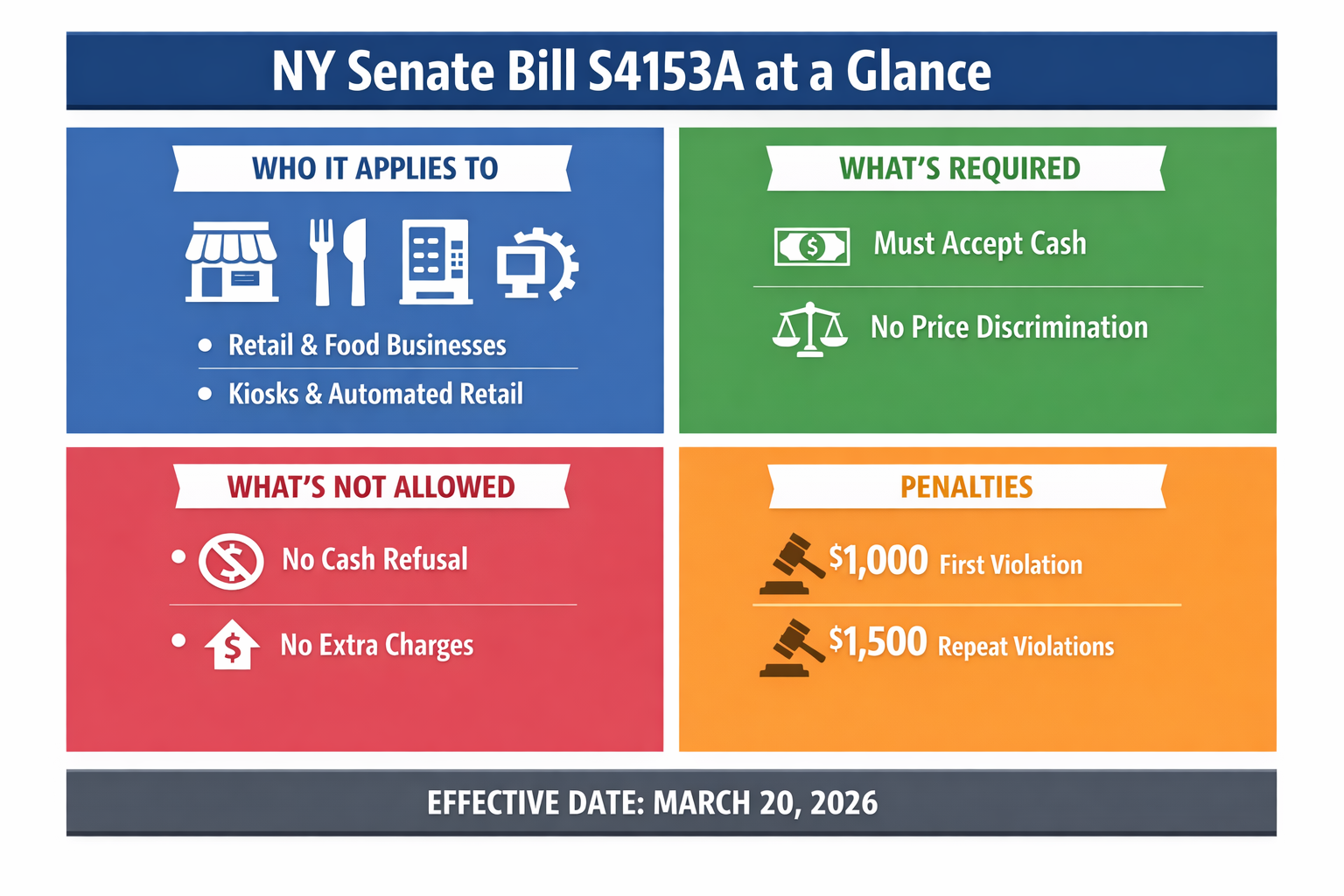
Senate Bill S4153A amends New York’s General Business Law to prohibit retail establishments from refusing cash for in-person transactions. The intent is to protect consumers who rely on cash — including unbanked and underbanked populations — and ensure equitable access to goods and services.
Key requirements:
- Businesses must accept cash for in-person purchases (they may decline bills larger than $20, like fifties and hundreds)
- Cash can't be charged a higher price than cashless payment
- Phone, mail, and internet transactions are exempt unless payment happens on the premises
- Civil penalties: $1,000 for a first violation, $1,500 for each subsequent one
The law took effect March 21, 2026.
Now that enforcement has begun, compliance is binary — either customers can pay with cash in a compliant way, or they can’t.
If you’re running smart vending machines, self-service kiosks, or any cashless retail setup, you are in scope.
The Law Is Being Enforced — Here's What That Means
The statute directs consumers to report violations to the New York Department of State's Division of Consumer Protection, and the required signage on cash-to-card devices must say so explicitly. That matters for cashless operators, because it means enforcement isn't driven by inspectors making rounds. It's driven by any customer who tries to pay with cash and can't. A single complaint can trigger a violation, and the penalties are $1,000 for a first offense and $1,500 for each one after that, per violation.
New York City businesses have lived under a similar local law since 2020, where enforcement was largely complaint-driven and uneven. The statewide law changes that picture: it covers every county in New York, it puts the Attorney General behind it, and it arrives as more states and cities adopt cash acceptance requirements of their own. Betting on quiet enforcement is a real risk with real numbers attached.
The Critical Exception: Cash-to-Card Conversion Devices
This is the provision that matters most for automated retail operators.
S4153A includes a narrow but critical exception allowing businesses to use an on-site device that converts cash into a prepaid card, as long as the device meets specific consumer protections.
To qualify, the cash-to-card device must:
- Charge no fees
- Allow deposits as low as $1
- Provide a printed receipt when requested
- Issue funds that do not expire
The device must also be accessible during normal business hours, which means uptime and reliability are part of compliance — not just convenience.
This exception exists specifically for environments where traditional cash handling isn’t practical. It’s how cashless stadiums, hospitals, universities, and automated retail operators can remain compliant without reverting to legacy cash operations. Learn more about how reverse ATMs work.
Why Cashless and Automated Businesses Are Most at Risk
Many modern retail environments were intentionally designed to eliminate cash:
For these operators, adding traditional cash acceptance isn’t just inconvenient — it’s often impractical or cost-prohibitive. Retrofitting payment kiosks to handle cash introduces:
- Increased hardware costs and ongoing maintenance
- Cash handling labor and security concerns
- Frequent service calls for bill jams and acceptor issues
- Slower transactions and longer lines
Without a compliant alternative, businesses face fines, forced equipment changes, and disrupted customer experiences.
Simply put, doing nothing isn’t an option.
How Reverse ATMs Solve the Compliance Problem
A reverse ATM, also known as a cash-to-card kiosk, converts physical cash into a prepaid card that can be used immediately in cashless and automated retail environments.
When properly deployed, reverse ATMs allow operators to:
- Meet S4153A’s cash acceptance requirements without handling cash at every endpoint
- Preserve the cashless infrastructure already in place
- Reduce cash handling risks, labor costs, and maintenance headaches
- Improve accessibility for customers who rely on or prefer cash
- Maintain clean, electronic transaction records across operations
Rather than stepping backward operationally, reverse ATMs allow businesses to move forward — compliantly.
What Makes a Compliant Cash-to-Card Solution
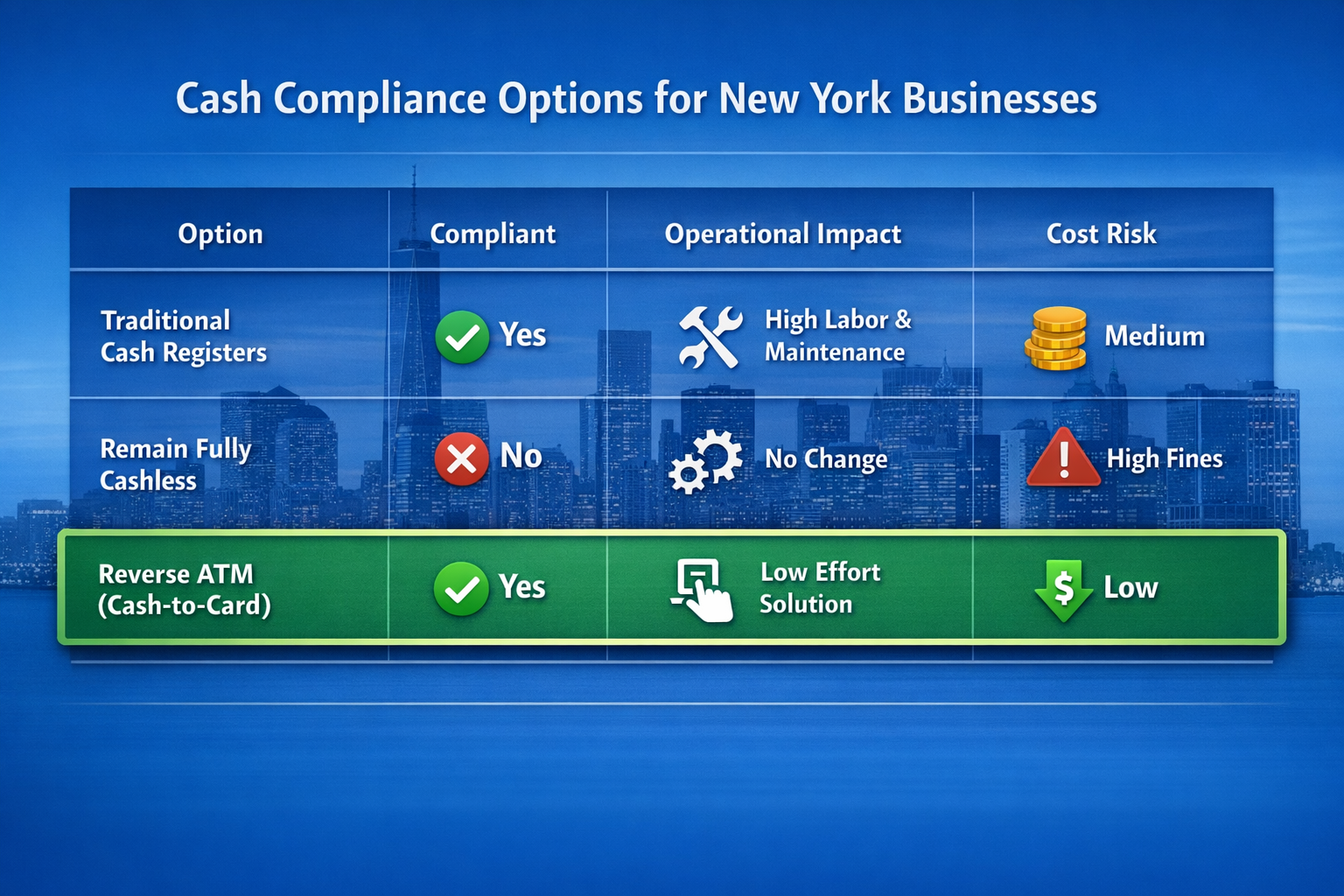
Not all reverse ATMs are created equal. To meet S4153A requirements, your deployment must meet both legal and operational standards.
Legal Requirements (Non-Negotiable)
Under GBL § 396-ii, an on-site cash-to-card device qualifies as compliant only if it meets all of the statute's conditions:
- Fee-free operation: No charge to convert cash to a prepaid card
- Low minimum deposit: Must accept deposits as small as $1
- Receipt on request: The device must provide a printed receipt upon request
- Non-expiring funds: Deposits onto the card cannot be subject to an expiration date
- No transaction limits: There can be no limit on the number of transactions completed with the card
- Malfunction coverage: If the device breaks down, the business is still on the hook. The statute requires a fallback so customers can pay while the device is out of service, which makes uptime, serviceability, and clear signage part of compliance rather than a nice-to-have
The malfunction provision is where the legal list and the operational list meet: a device that's down isn't just losing transactions, it's a compliance gap.
Operational Reality (Where Most Solutions Fall Short)
Beyond the legal checklist, real-world performance matters:
- User experience: Can customers easily understand and use the device?
- Uptime and reliability: What happens if a bill acceptor jams or a printer runs out?
- Serviceability: How quickly can issues be resolved in unattended environments?
- Scalability: Can the solution be deployed across multiple locations quickly?
This is where working with an experienced kiosk manufacturer makes a difference. Learn more in our 8 common questions about cash-to-card kiosks.
Fast Deployment Matters — and It’s Still Possible
If you’re not yet compliant, every day of operation is exposure. The deployment path is the same as it was before the deadline, and it’s still fast.
Unlike fully custom kiosk builds, REDYREF’s cash-to-card solutions are production-ready and designed for rapid deployment.
Typical deployment timeline for an off-the-shelf cash-to-card kiosk:
- Solution selection & configuration: 1–2 weeks
- Branding (custom vinyl wraps): Runs in parallel
- Manufacturing & staging: 1–2 weeks
- Delivery & placement: Days, not months
- Activation & staff orientation: Minimal
For many operators, this means a compliant solution can be ordered, delivered, and live within a few weeks — if action is taken now.
At this stage, compliance is no longer about strategy. It’s about execution.
How REDYREF Helps Operators Stay Compliant
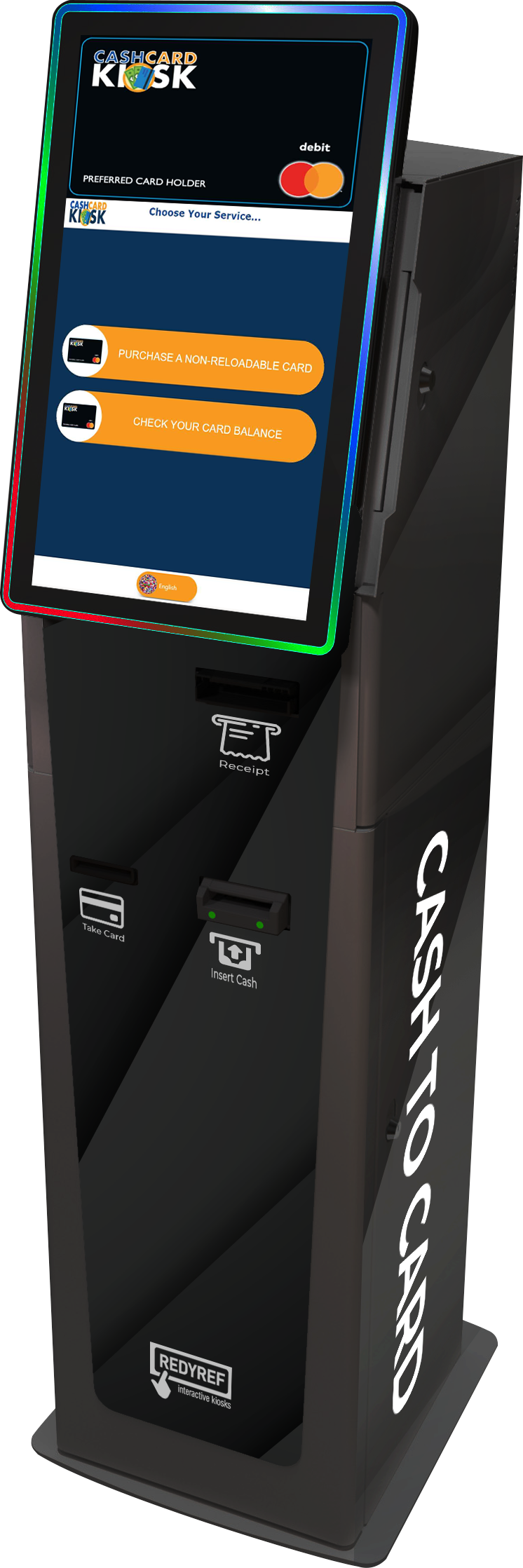
REDYREF has been designing and manufacturing self-service kiosks and automated retail solutions for over 20 years, supporting operators in regulated, high-traffic, and multi-location environments where compliance isn’t optional.
REDYREF’s cash-to-card kiosk solutions are built for:
- State and municipal regulatory compliance
- High-traffic unattended environments
- Long-term reliability and serviceability
- Rapid deployment without custom engineering delays
- Scalable rollouts across multiple sites
REDYREF works directly with operators to ensure deployments aren’t just functional — they’re defensible from a compliance standpoint, today and as similar legislation expands to other states. Explore the versatility of cash-to-card kiosks and discover 8 uses for reverse ATMs.
Frequently Asked Questions About New York’s Cash Acceptance Law (S4153A)
Does New York require businesses to accept cash?
Yes. New York General Business Law § 396-ii requires food stores and retail establishments to accept cash for in-person transactions. Businesses may refuse cash bills denominated above $20, and telephone, mail, and internet transactions are generally exempt unless payment takes place on the business premises.
Are reverse ATMs or cash-to-card kiosks allowed under New York’s cash law?
Yes. The law specifically allows an on-site device that converts cash into a prepaid card, provided the device meets all statutory requirements. This allows qualifying businesses to maintain cashless points of sale while still giving customers a way to use cash.
What does a cash-to-card kiosk need to do to comply with S4153A?
A qualifying cash-to-card device must charge no fee, accept deposits as low as $1, provide a receipt upon request showing the amount deposited, and place the funds on a prepaid card that does not expire. The card also cannot limit the number of transactions a customer may complete.
Do businesses have to accept cash at every point of sale?
No. A food store or retail establishment can qualify for the cash-to-card exception by providing a compliant conversion device on the premises. Customers can convert cash to a prepaid card and then use that card to complete their purchase within the establishment.
What happens if a cash-to-card kiosk stops working?
If the cash-to-card device malfunctions, the business must accept cash directly for as long as the device is not functioning as required. The business must also place a conspicuous sign on or immediately next to the device explaining that cash must be accepted during the outage and that violations may be reported to the New York Department of State Division of Consumer Protection.
What are the penalties for violating New York’s cash acceptance law?
A food store or retail establishment that violates the law may face a civil penalty of up to $1,000 for the first violation and up to $1,500 for each subsequent violation.
When did New York’s cash acceptance law take effect?
New York’s statewide cash acceptance law took effect on March 21, 2026 and is now codified as General Business Law § 396-ii. Businesses covered by the law are required to comply now.
Get Compliant With New York’s Cash Acceptance Law
New York Senate Bill S4153A took effect in March 2026. REDYREF helps businesses deploy compliant, fee-free cash-to-card kiosks that meet legal requirements without disrupting operations or abandoning cashless infrastructure.
Contact REDYREF today to evaluate your current payment setup and deploy a compliant, off-the-shelf cash-to-card solution within weeks — not months — with confidence and close the compliance gap now.