Physical retail is not disappearing — it's evolving. As e-commerce expectations reshape customer behavior, brick-and-mortar stores must integrate digital capabilities directly into the in-store experience. RFID-enabled retail automation kiosks bridge that gap, connecting physical environments with real-time inventory, digital checkout, and unified commerce systems.
The mistake many retailers make is treating automation as a checkout alternative rather than infrastructure. Retail automation kiosks are not faster registers — they are access points into integrated commerce platforms that extend inventory, capture demand, and unify customer data across channels.
Retailers no longer compete solely on product selection — they compete on convenience, personalization, and operational efficiency. In-store automation enables physical stores to operate with the intelligence and flexibility customers already expect online.
What's Driving In-Store Retail Automation Today?
The shift toward retail automation reflects structural change in how stores must operate:
Customer expectations and inventory limitations: Shoppers expect inventory visibility, product information, mobile integration, and frictionless checkout. Physical stores cannot stock unlimited SKUs, yet customers browsing in-store should access the same product selection available online. Endless aisle kiosks extend available inventory without increasing square footage, capturing demand that would otherwise be lost.
Labor pressure and operational efficiency: Retailers face staffing challenges, rising wages, and margin compression. Automation reduces checkout friction and queue congestion while enabling staff to focus on product expertise, customer service, and high-value interactions rather than transaction processing.
Technology integration requirements: Modern POS, CRM, inventory management, and loyalty systems must function as unified platforms. Retail automation kiosks serve as customer-facing interfaces into backend commerce systems, enabling seamless experiences across digital and physical channels alike.
Retail automation allows physical stores to compete with digital-native retailers without sacrificing the advantages of in-person engagement.
Core Retail Automation Strategies
Endless Aisle
Endless aisle kiosks extend a store's available inventory beyond what is physically displayed. Customers browse the full catalog, check real-time availability across locations and warehouses, and order out-of-stock items for home delivery or in-store pickup.
Rather than losing a sale due to limited shelf space or stockouts, retailers capture demand digitally while maintaining the in-store experience. This turns physical locations into fulfillment-enabled showrooms without requiring additional square footage.
Unified Commerce: Beyond Omnichannel
Omnichannel ensures consistent branding across platforms. Unified commerce goes further — it connects POS systems, inventory management, customer profiles, payment processing, and order fulfillment into a single operational ecosystem.
Retail kiosks become access points into that ecosystem, enabling customers to shop, pay, return, or reorder products seamlessly across channels. Purchase history, loyalty rewards, saved preferences, and payment methods follow customers between mobile, web, and in-store experiences.
The difference is not cosmetic. It is architectural.
Assisted Selling and Remote Expertise
Interactive retail kiosks can connect customers with remote sales associates via video, provide detailed product comparisons, integrate loyalty accounts directly into the shopping experience, and surface personalized recommendations based on purchase history.
This allows retailers to:
Offer expert-level guidance without expanding in-store staffing
Maintain brand consistency and product knowledge across locations
Capture behavioral data on customer engagement and preferences
Retail automation enhances human interaction rather than replacing it.
Unified Commerce in Action
Consider a customer shopping for athletic footwear in a specialty sporting goods store. Through an integrated retail automation system:
The customer scans a product displayed on the floor using a kiosk interface. The system shows real-time inventory across nearby store locations and the brand's warehouse.
The customer adds items to a unified cart — combining in-store purchases with items for home delivery. Loyalty rewards automatically apply.
Order confirmation includes tracking for shipped items and pickup notifications. Returns can be processed at any location.
The experience is continuous — not fragmented across disconnected systems. This differentiates modern retail automation from simple self-service terminals.
The Benefits of Retail Automation Kiosks
When deployed strategically as part of unified commerce infrastructure, in-store automation delivers measurable impact:
Increased sales capture: Endless aisle prevents lost sales due to out-of-stock items or limited shelf space.
Improved customer experience: Digital integration reduces friction and eliminates checkout queues.
Operational efficiency: Automation enables staff redeployment to higher-value service roles.
Data visibility and customer intelligence: Integrated systems provide actionable insights into customer behavior.
Reduced real estate pressure: Endless aisle allows retailers to operate profitably in smaller footprints.
Retail automation is not about replacing staff — it equips stores with digital infrastructure that supports growth and competitive positioning.
Technology Integration Requirements
Effective retail automation requires more than kiosk hardware — it demands systems integration across the retail technology stack:
Point-of-Sale (POS) Integration: Real-time transaction processing and unified checkout
Inventory Management Systems: Live product availability and fulfillment routing
Customer Relationship Management (CRM): Purchase history and personalization
Order Management and Fulfillment: Ship-from-store and BOPIS
Analytics and Business Intelligence: Conversion analysis and merchandising insights
Retail kiosk software must function as middleware connecting customer interfaces to backend commerce platforms, not as standalone applications.
Over the last ten years, self-service kiosks have drastically changed how businesses connect with their customers. These digital kiosks make life easier for everyone, offering a faster, more convenient, and even enjoyable way to handle tasks like making purchases, looking up information, or placing orders. By simplifying processes and reducing the need for staff involvement, they’re making life easier for businesses and users alike. Let’s dive into what makes self-service kiosks so impactful.
10 Benefits of Self Service Kiosks
Self service kiosks aren’t just about automation—they’re about delivering smarter, faster, and more personalized customer experiences. Here are 10 key benefits of implementing self-service kiosks:
1. Convenience: Customers can handle tasks on their own time, whether it’s placing an order or checking information, even outside regular business hours.
2. Efficiency: With streamlined processes, kiosks minimize wait times and improve operations, keeping lines moving and customers satisfied.
3. Accuracy: Customers input their own information, reducing errors and ensuring seamless transactions.
4. Customization: Kiosks can be tailored to display personalized recommendations, reflect a brand’s aesthetic, or meet specific business needs.
5. Data Collection: Valuable insights into customer behavior and preferences help businesses make data-driven decisions to improve services.
6. Customer Engagement: Interactive features like maps, product catalogs, and multimedia displays make the experience more engaging and enjoyable.
7. Cost Savings: By handling routine tasks, kiosks reduce staffing needs, cutting labor costs while freeing employees for high-value roles.
8. Upselling Opportunities: Strategic prompts encourage customers to explore additional products or services, boosting revenue.
9. Queue Management: Kiosks reduce congestion at service counters, making peak hours more manageable and improving customer flow.
10. Accessibility: Designed to accommodate everyone, kiosks can include features like large text, audio output, and tactile interfaces for those with disabilities.
7 Important Types of Self-Service Kiosks
Businesses across industries are finding innovative ways to leverage self service kiosks. Here are 7 common types and how they’re used:
1. Retail Kiosks: Perfect for tasks like order placement, product browsing, and self-checkout. Customers enjoy a more seamless shopping experience while businesses benefit from reduced checkout lines.
2. Foodservice Kiosks: Allow diners to customize meals, place orders, and make payments—speeding up service and reducing order errors.
3. Financial Kiosks: Offer services like reverse ATM cash-to-card transactions, withdrawals, fund transfers, and account balance checks, saving time for customers and financial institutions alike.
4. Ticketing Kiosks: Simplify ticket purchases for events, travel, or attractions, reducing wait times and enhancing user convenience.
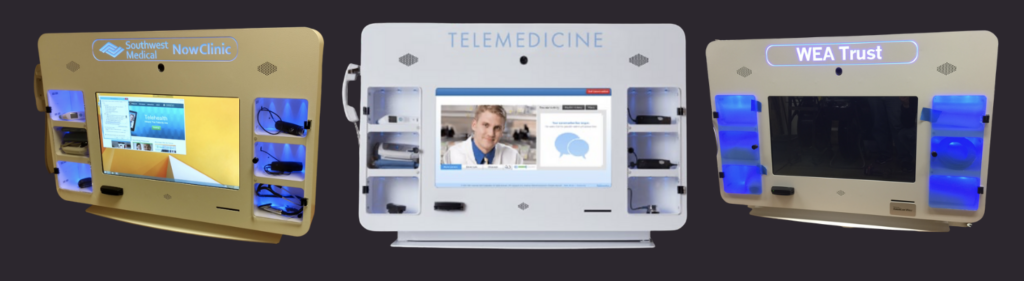
5. Healthcare Kiosks: Streamline check-ins, appointment scheduling, and payments, improving patient flow and reducing administrative workloads.
6.Information Kiosks: Provide visitors with maps, directions, and facility details at locations like malls, airports, and tourist attractions.
7. Interactive Wayfinding Kiosks: Help users navigate complex spaces with real-time directions and information about nearby amenities or points of interest.
Each type of kiosk is designed to meet specific business needs, offering a tailored solution to improve customer interactions and operational efficiency.
Why Partner with REDYREF for Self Service Kiosks?
With decades of experience and a reputation for innovation, REDYREF is a trusted leader in kiosk manufacturing. Here’s what sets us apart:
• Comprehensive Solutions: REDYREF offers customizable indoor and outdoor kiosks for industries ranging from retail and hospitality to healthcare and transportation.
• High-Quality Craftsmanship: Our kiosks are built to last, with durable materials like stainless steel and advanced technology that ensures reliability.
• Full-Service Support: From design and manufacturing to installation, maintenance, and repair, we’re with you every step of the way.
• Customization Options: Tailor your kiosk to reflect your brand with features like custom wraps, powder coating, and software integrations.
• Data-Driven Insights: Our kiosks are designed to collect actionable data, helping businesses optimize their operations and better serve their customers.
Self-Service Kiosks: The Future of Customer Experience
By investing in self-service kiosks, businesses can streamline operations, improve customer satisfaction, and drive revenue growth. Whether you’re looking to reduce wait times, enhance personalization, or gather valuable customer insights, kiosks offer a scalable solution for almost any industry.
Ready to explore the possibilities? Contact us today or call 1-800-626-3603 to learn how our innovative kiosks can transform your business. Let’s build the future of customer interaction—together.
REDYREF Interactive, an industry leader in self-service kiosk design and manufacturing, has released its latest software suite: enGAGE.Touch. This platform is built on the foundation of REDYREF's digital directory software module, which can be used aloneor integrated with advanced digital wayfinding and visitor management modules for more complex needs.
Riverdale, NJ (PRWEB) July 11, 2017 REDYREF Interactive has launched a new and innovative wayfinding software suite: enGAGE.Touch. The core of this system is the cutting-edge digital building directory module, which can be seamlessly integrated with additional software modules and semi-custom enclosures for environments that require more complex solutions.
Innovative, Modular, Intuitive Electronic Building Directory Systems
REDYREF’s enGAGE.Touch digital building directories go further than just helping visitors to quickly locate companies, departments or personnel, says Will Pymm, Vice President and Managing Partner. “The new enGAGE.Touch Mobile Handover feature makes it easy for guests to transfer maps and directions from the directory right to their smartphone. Integration with Google Maps means wayfinding information is always accurate and up-to-date, not just within the facility, but also for those requiring assistance with the surrounding area. It’s truly an all-in-one solution.”
Digital Directories Developed with Flexibility in Mind
enGAGE.Touch electronic directory systems may be customized to meet a wide range of business needs, including support for multiple floor and campus maps. User experience is enhanced by allowing interactive directory search by multiple criteria, including employee, company, department, floor or room name/number. Updates are simplified by allowing editing permissions to be granted to multiple users, including office tenants.
An Electronic Directory for Every Environment
With multiple opportunities for customization, enGAGE.Touch digital directory software is the premier choice for multiple deployment environments. From electronic lobby directories to educational campus signage, the easy-to-use, interactive directory interface enhances visitor satisfaction by reducing the stress of wayfinding, and tenant satisfaction by allowing anyone with access to manage their own data, reducing and often eliminating common data entry issues. Visitors and tenants alike benefit when critical building and campus updates and information are communicated digitally and able to be updated as needed.
Integrated Software and Kiosk Enclosure Solutions, Simplified
enGAGE.Touch electronic building directory software was developed to be integrated with any of REDYREF's kiosk enclosures, all of which are designed and manufactured in-house. From custom, built-to-order digital building directories, to modular self-service kiosks from the semi-custom enGAGE line, REDYREF's kiosk enclosures can be tailored to the exact use case and environment. When combined with the new enGAGE.Touch software suite, guests are able to navigate a single office building or a large multi-facility campus using detailed floor and campus maps, ensuring they are able to reach their intended destinations on-time and without unnecessary stress or frustration.
About REDYREF
Established more than 100 years ago, REDYREF Interactive is a vertically-integrated manufacturer and developer of electronic building directories, digital wayfinding solutions and self-service kiosks.
Cash collection kiosks have been around for decades, most notably in the form of automated teller machines (ATMs). However, in the years between the debut of ATMs and today, the need for new and more sophisticated cash collection kiosks has soared far beyond banking, and into such industries as gaming, medical marijuana dispensing and others where security is of paramount importance and average transactions are generally higher-dollar amounts.
How has the kiosk manufacturing industry responded to customers' needs for high-security cash collection kiosks?
Manufacturers like REDYREF are combining the best of new technology with old-school fraud protection to help their customers keep their kiosks secure. For example, a medical marijuana dispensary kiosk must be able to handle cash deposits, as many dispensaries only handle cash transactions. So kiosks have to be secure not just physically, but also technologically.
The kiosk itself must incorporate levels of fail-safes such as shutters and other physical barriers to prevent theft; on the other hand, it must also marry these measures to modern fraud-prevention features, such as cash tracking sensors, bill counter/handlers and sophisticated digital kiosk software that is able to recognize counterfeit bills and coins. This last issue is one of the more difficult for those in the security industry to deal with, as it’s only become easier to create fake currency over the last decade. Therefore, security specialists have to constantly stay one step ahead of criminals, rather than simply responding to problems as they occur.
What types of technologies are currently available to help prevent fraud?
There are devices available for use within cash collection kiosks that are able to analyze the UV signature of the ink on printed bills, or the precise density of accepted coins; these are two of the most common types of fraud prevention technology. There are also devices that can detect the metallic strip integrated into most American paper currency, analyzing its position and even chemical makeup. This is truly an area of research that seems to have no end in sight at the moment, and with the self-service kiosk industry continuing to gain steam, it stands to reason that security advances like the ones listed here will only keep coming.
Even though technology does its best to keep up, cash handling is never likely to be a simple process. However, it is a necessary one for many businesses in this day and age. Because it takes many levels of precise coordination in order to ensure transactions are secure, the key to success is partnering with an experienced, vertically integrated manufacturer like REDYREF. Contact us today at (800) 628-3603 today or request a quote online and we’ll be with you every step of the way to ensure that your cash collection kiosk meets every one of your business’ security needs for its unique deployment environment.
Automated retail has evolved from mechanical coin-operated machines to sophisticated RFID-enabled smart systems serving fresh meals, high-value products, and specialized inventory across healthcare, corporate, education, and retail environments.
What began as basic snack and beverage dispensing has transformed into a $50+ billion global industry driven by labor cost pressures, 24/7 convenience expectations, and technology that enables precise inventory management and real-time sales data.
Automated retail is no longer a niche vending upgrade — it is a distributed retail infrastructure model. Organizations that still view vending as a snack machine are missing the shift toward intelligent, unattended commerce operating across industries. What once appeared as novelty retail in airports and malls has evolved into scalable unattended infrastructure serving healthcare systems, universities, corporate campuses, and hospitality environments.
Why Automated Retail Is Accelerating Now
The current expansion of unattended retail reflects converging economic and operational pressures rather than technology novelty:
Labor availability and cost: Persistent workforce shortages and rising minimum wages make 24/7 staffed retail increasingly uneconomical. Automated systems eliminate overnight shift labor while maintaining service availability.
Consumer behavior expectations: Mobile-first consumers expect immediate product access on their schedules, not business operating hours. Unattended retail meets demand for convenience without requiring human interaction.
Real estate economics: Rent per square foot in high-traffic locations (airports, hospitals, campuses) makes traditional staffed retail prohibitively expensive. Automated systems generate revenue in spaces too small or unprofitable for conventional stores.
Retail shrink and theft: High-theft product categories previously kept behind counters can be merchandised through secure dispensing systems, reducing labor costs while maintaining security and inventory accuracy.
Operating margin pressure: Retailers and operators require data-driven inventory decisions, dynamic pricing, and precise sell-through tracking. Cloud-based automated systems provide real-time visibility that mechanical vending never could.
This combination of factors—not any single technology breakthrough—is driving automated retail adoption across diverse industries.
From Mechanical Vending to Smart Unattended Retail
Traditional vending relied on mechanical systems: springs, coils, and gravity-fed dispensing. Product selection was limited to shelf-stable packaged goods. Restocking required manual inventory counts. Sales data came from coin counters.
Modern unattended retail systems use:
RFID or computer vision technology tracking individual items from load to purchase
Refrigeration and climate control supporting fresh and frozen products
Touchscreen interfaces with product search, filtering, and nutritional information
Cashless payment processing including mobile wallets and contactless cards
Modular scalability from single units to distributed networks
This infrastructure supports business models that weren't viable with mechanical vending: fresh meal programs, high-value electronics dispensing, controlled pharmaceutical access, and operator-branded food service expansion.
Technology Infrastructure: What Enables Modern Unattended Retail
Effective automated retail deployments integrate multiple systems beyond physical hardware:
Item-Level Tracking Technology
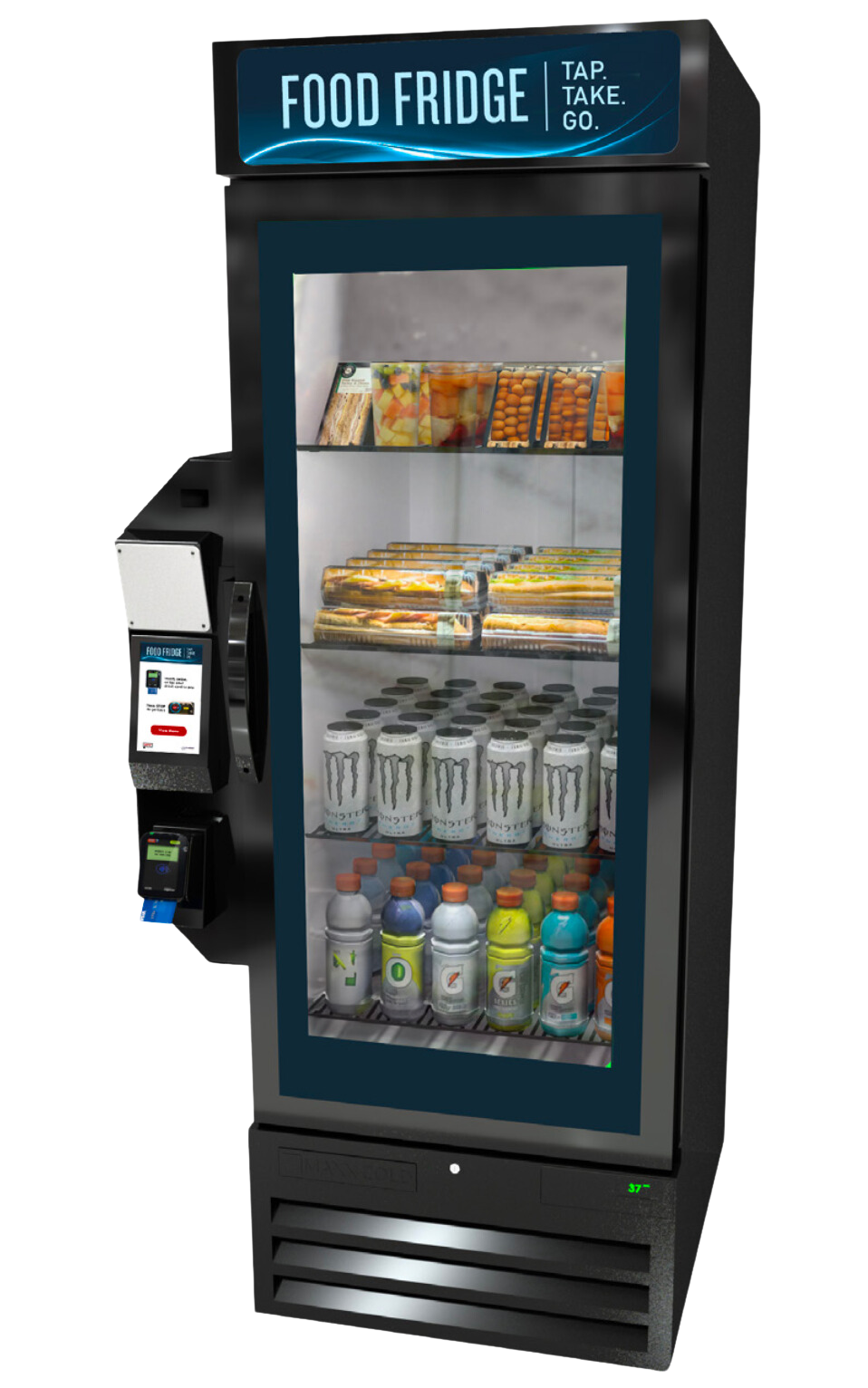
RFID Systems:RFID vending technology uses radio-frequency identification tags on individual products. When removed from the unit, the system registers the specific item, processes payment, and updates inventory in real time without mechanical dispensing that can jam or miscount.
Computer Vision: AI-powered camera systems identify products visually as customers remove them, eliminating physical tags but requiring more sophisticated software and processing. RFID compared to AI camera technology presents tradeoffs in accuracy, cost, and operational complexity.
Environmental Controls
Commercial refrigeration with remote temperature monitoring ensures food safety compliance and alerts operators to equipment issues before product spoilage occurs.
Payment and Access Integration
Cashless payment systems support credit/debit cards, mobile wallets, campus cards, employee badges, and prepaid accounts, enabling diverse business models and customer segments.
Cloud Management Platforms
Centralized dashboards monitor inventory levels, sales performance, equipment status, and restocking needs across distributed locations, enabling predictive analytics and route optimization.
This technology stack—tracking, refrigeration, payment, connectivity, and software—operates as an integrated system rather than isolated components.
Fresh Food Vending Within the Automated Retail Ecosystem
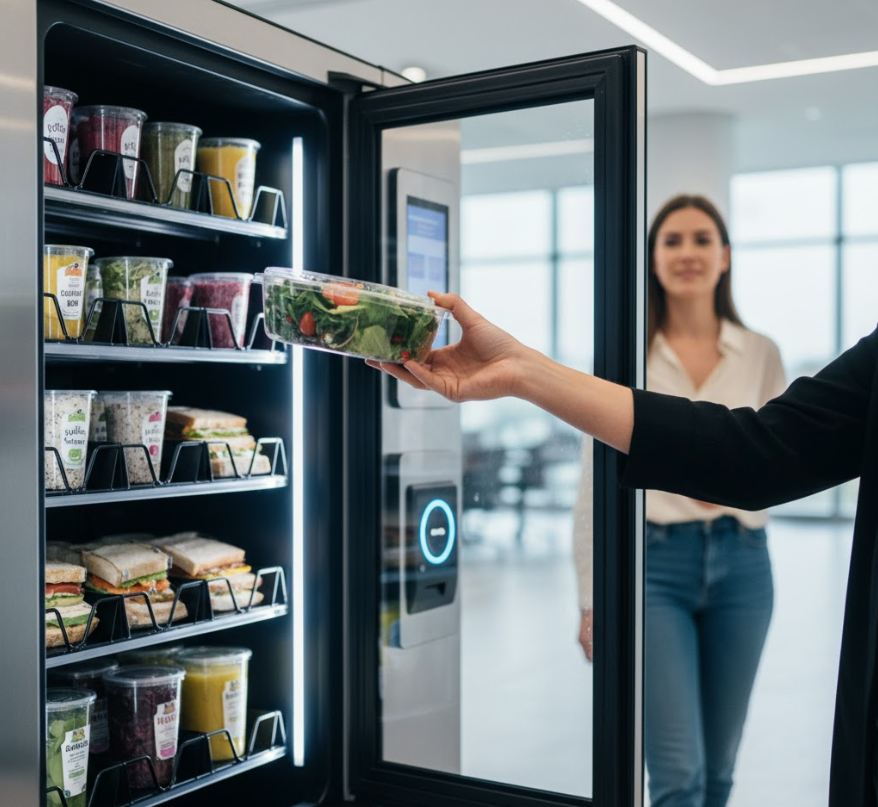
The most significant growth in unattended retail is fresh meal vending serving locations where traditional food service is impractical or unavailable.
Universities and Campus Environments
Residence halls, libraries, and academic buildings operate 24/7 but dining facilities don't. Fresh food vending for universities provides students with healthy grab-and-go meals during late-night study sessions, early mornings, and between classes.
Healthcare Facilities
Hospital staff working overnight shifts, family members in waiting areas, and outpatient visitors need meal access when cafeterias are closed. Smart fresh food solutions for healthcare support 24/7 operations without labor costs.
Corporate Offices
Companies offering employee meal programs can provide subsidized or free meals without operating full cafeterias, reducing overhead while maintaining benefits that support retention and workplace satisfaction.
Manufacturing Facilities
Plants operating multiple shifts require meal access for workers who can't leave facilities during breaks. Smart fresh meal vending for manufacturing supports shift work without dedicated food service staff.
Hotels and Co-Working Spaces
Hotels serve guests preferring convenient alternatives to room service or hotel restaurants. Co-working facilities differentiate their amenities with premium food access without requiring staffed cafés.
Restaurants and Food Service Operators: Revenue Expansion Through Unattended Retail
For established food businesses, smart vending represents channel expansion without new real estate costs. Restaurants extend operating hours beyond kitchen staffing. Caterers place units in office buildings, creating recurring revenue independent of event bookings. Food trucks establish permanent satellite locations serving their menus when trucks aren't physically present.
Beyond Food: Other Automated Retail Applications
While fresh food drives current growth, unattended retail infrastructure supports diverse product categories:
Electronics and consumer tech in airports and transit hubs provide immediate access to phone chargers, headphones, and travel accessories where rent makes traditional stores uneconomical.
Personal protective equipment (PPE) in manufacturing and construction sites dispenses safety gear through controlled access systems tracking usage by employee.
Cosmetics and personal care from premium brands deployed in malls, airports, and hotels where self-service appeals to convenience-focused shoppers.
Pharmaceuticals and health products in healthcare settings, workplaces, and public venues provide over-the-counter medications and first aid supplies with compliance tracking.
Retail loss prevention enables high-theft items—razors, infant formula, cosmetics—to be merchandised securely, reducing labor costs while maintaining inventory control.
The Business Case for Automated Retail
Organizations deploy unattended retail to address specific operational challenges:
Labor cost reduction: 24/7 access without staffing overnight shifts or low-traffic periods
Real estate efficiency: Revenue per square foot exceeds traditional vending while requiring lower overhead than staffed retail
Data-driven operations: Real-time sales data enables predictive restocking, spoilage prevention, and customer behavior analytics
Brand extension: Established businesses reach new locations and customer segments without opening storefronts
Margin optimization: Capture sales during hours when traditional service is unavailable or uneconomical
Organizations considering automated retail should assess:
Technology approach: RFID provides proven item-level tracking reliability; computer vision eliminates tagging but requires more sophisticated software and processing power.
Deployment scale: Single units versus RFID vending micro markets require assessment of space, traffic, and revenue potential.
Hardware durability: Commercial-grade refrigeration, public-use-rated touchscreens, and modular components enabling field service without full unit replacement.
Software capabilities: Cloud platforms supporting multi-location management, integration with existing systems, and data export preventing vendor dependency.
Operational support: For food service applications, evaluate whether providers offer fulfillment partnerships or require independent operations management.
The Future of Automated Retail
Several trends are shaping unattended retail's evolution:
Sustainability focus:Smart vending reducing food waste through precise inventory management and dynamic pricing on items approaching expiration.
Delivery integration: Unattended pickup lockers for delivery orders, ghost kitchen meal dispensing, and hybrid models combining delivery with self-service access.
Non-traditional locations: Apartment buildings, residential complexes, transit stations, and community spaces becoming retail endpoints.
Personalization: Loyalty programs, purchase history recommendations, and customized pricing integrated into unattended interfaces.
Expanded categories: Fresh flowers, local artisan products, restaurant partnership meals, and specialty items previously requiring staffed retail.
REDYREF's Integrated Automated Retail Solutions
REDYREF designs and manufactures integrated unattended retail systems for public and commercial environments, combining commercial-grade hardware, secure payment integration, refrigeration infrastructure, RFID technology, and cloud-based management platforms to support scalable deployments across distributed locations.
Our smart fresh food vending solutions serve operators, food service companies, and facility managers implementing programs ranging from single-location pilots to networks serving thousands of daily transactions.
Whether addressing student meal access, 24/7 healthcare operations, corporate employee programs, or restaurant channel expansion, automated retail systems can be engineered to specific operational requirements and business models.
Frequently Asked Questions
What is automated retail?
Automated retail refers to self-service systems enabling product purchase and dispensing without staff assistance, ranging from traditional vending machines to RFID-enabled smart systems supporting fresh food, high-value products, and sophisticated inventory management.
How does RFID vending work?
RFID vending uses radio-frequency identification tags on individual products. When an item is removed, the system reads the tag, processes payment, and updates inventory in real time without mechanical dispensing.
What types of products work in automated retail?
Fresh and prepared foods, beverages, electronics, cosmetics, pharmaceuticals, PPE, health products, and merchandise suitable for self-service purchase with appropriate environmental controls.
Can restaurants use automated retail to expand their business?
Yes. Restaurants, caterers, and food service operators use smart vending to extend operating hours, reach new locations, and create recurring revenue without opening additional storefronts or staffing overnight shifts.
What's the difference between traditional vending and unattended retail?
Traditional vending relies on mechanical dispensing serving shelf-stable goods. Modern unattended retail uses RFID or computer vision, supports fresh and high-value products, provides real-time inventory management, and enables diverse business models including operator partnerships and branded retail extensions.
Why is automated retail growing now?
Converging factors including labor shortages, rising wages, 24/7 consumer expectations, real estate cost pressure, and demand for data-driven inventory decisions are making unattended retail economically compelling across industries.
Automated retail is not a trend — it is a structural shift in how goods are merchandised, accessed, and distributed in physical environments. Organizations that treat it as infrastructure rather than novelty will be positioned to capture its full economic potential.
The incredible growth of digital signage, including interactive wayfinding kiosks and digital building directories, has been nothing less than stunning over the last decade and there’s seemingly no end in sight. And opportunities to integrate these kinds of technologies seem practically limitless, too. So far in our blog series, we’ve discussed how health care and education environments are incorporating kiosks and building directories into their campuses in order to increase user satisfaction and create new avenues of communication with these populations. Today, we’ll discuss how malls and mixed-use developments are utilizing these strategies to do the same for their customers.
The Growth of Mixed-Use Developments in Urban Centers
Studies have shown that more and more people are heading back into urban areas to make their homes. These are often areas where land is at a premium, leading developers to build up, instead of out. At the same time, discerning consumers want to maintain the feeling of a neighborhood, where they can shop, dine and even work, all within a walkable distance of their residence. The collision point of these two separate desires has resulted in a building boom of mixed-use developments -- also called “lifestyle centers” -- in both cities and inner-ring suburbs. With upscale architecture, loads of amenities and easy access to both work and play, it’s no wonder their popularity is at an all-time high.
How Digital Directories Simplify Wayfinding in Mixed-Use Developments
Because the real estate involved in mixed-use developments is so densely packed, interactive wayfinding kiosks can be not just helpful, but utterly necessary in order to give consumers -- both visitors and residents -- the kind of personalized experience that’s generally expected in these types of high-end environments. The ability to easily navigate and interact with multiple buildings of retail, apartments and business offices, combined with a seemingly endless array of restaurant choices from fast-casual to four-star, plus entertainment centers that include movie theaters and even plush bowling and gaming “lounges” is the key to long-term customer satisfaction.
Interactive Kiosk Capabilities in Mixed-Use Environments
Besides the wayfinding capabilities of these kiosks, they can also function in other capacities with a simple touch or swipe of a finger. This type of interactivity can include functionality such as digital building directories for a single building or an entire mall development, and information about specific stores from ongoing sales and specials to store hours. Additionally, wayfinding kiosks can serve as information hubs to communicate details about anything from events, to available housing to current movie times, and can even be integrated with printers so tickets are able to be purchased right from the kiosk’s screen.
What other industries are successfully deploying digital wayfinding and building directories? We invite you to follow REDYREF as we continue to explore the future of these technologies over the coming weeks. Already know that you want to take the plunge into high-tech wayfinding kiosks? REDYREF's experts are available to assist organizations of all sizes; just give us a call at (800) 628-3603 ext 525 or submit a request for proposal online and our team will be with you every step of the way.
Most interactive kiosks are intended for indoor use in settings such as food service, retail, banking or for other similar consumer needs. This makes it easy for digital outdoor kiosks to get lost in the shuffle, as there is less demand and need for these solutions. However, when you need a touch screen kiosk for an outdoor application, there is simply no room for error or compromise, because these kiosks are truly in a different league than typical kiosks solutions.
Outdoor Digital Kiosks: Built to Withstand Almost Anything
An outdoor kiosk has to be built with an enclosure that is able to withstand much harsher environmental conditions than just consumer use and regular wear and tear. Instead, they need to be able to handle extreme weather conditions, ranging from freezing temperatures and snow, strong winds, direct sunlight, heavy rain and temperatures as high as 140 degrees Fahrenheit. To add to the complications of deploying an outdoor kiosk solution, because they have to be more rugged than their indoor siblings, many are often lacking in terms of style or usability. The enclosure becomes less of a focus outside of pure durability and the ability to handle the weather and climate around it.
Building Outdoor Digital Kiosks For Function and Form
REDYREF recognizes the need for high-end, aesthetically pleasing design no matter where a kiosk is located and this is when our experience as a vertically integrated kiosk manufacturer truly benefits our customers. With engineers and designers in-house, we have been able to dedicate many project hours to creating flexible outdoor kiosk options that offer not just durability, but also excellent design and functionality. Our two most popular touchscreen kiosks are:
The Bazooka is available in both indoor and outdoor versions, and is easily the most modular kiosk we have engineered to date. It is easily customized for almost any component and its capabilities are limited only by the imagination of our clients.
The Skyline is also available in both indoor and outdoor versions, and was engineered especially for use cases where larger LCD monitors may be required. It also stands out due to its unique, portrait-style monitor configuration.
While there will always be challenges to planning and deploying an outdoor digital kiosk program, the process can be greatly simplified by partnering with an experienced, vertically integrated manufacturer like REDYREF. Contact us today at (800) 628-3603 today or request a quote online and we’ll be with you every step of the way to ensure that your kiosk deployment meets every one of your business’ unique needs and requirements.
FOR IMMEDIATE RELEASE:
RedyRef Interactive Kiosks launches the enGAGE™ line of standard kiosks that can be used as it exists or be semi-customized to meet the component requirements of any kiosk application.
Riverdale, New Jersey. – March 5, 2015 – RedyRef, a turn-key self-service kiosk solution provider announced that they have launched the enGAGE™ line of standard kiosks which features over a dozen different styles for kiosk deployers to utilize as the basic platform of their kiosk requirement. The platform can be used as it exists or be semi-customized to meet the component requirements of any kiosk application.
Platform Approach - It is simple, the enGAGE™ line is built on a standard frame concept that was devised on the idea that retail sells real estate by the square foot. Each enGAGE™ is designed on a frame system that is standardized by the foot –12”, 24” 36”, 48” and so on, so that the footprint easily fits within the parameters of retail space allocations. And, of course, since the enGAGE™ is a frame system, it can easily be customized to other sizes if needed to meet the component requirements of the kiosk component array.
Customizable Skins - The next part of the modularity of the design is in the fact that the metal cabinets, that we call skins, are mounted/hung from the frames, which are also completely customizable to the needs of the sizes of the components that they house.
Branding Platform - Finally, the skins are not only customizable but also they make for a great branding platform for graphics and decals that complete the holistic intentions of the enGAGE™ modular design. Best of all, the design allows us to meet the needs of your brand and performance while managing cost and speed to the market. Additional benefits include the ability to choose from a variety of monitor sizes to fit your needs, optional custom vinyl-wrapped graphics to further strengthen your brand, the possibility of having a branded header on the kiosk, and extensive equipment options.
Software Solutions - As with all of our kiosks, we provide cutting-edge kiosk software that can suit the needs of your company whether you need an electronic directory, interactive way-finding program, digital signage and much more!
The enGAGE™ kiosk can seamlessly blend into any environment and we have the capabilities to make custom modifications on standard kiosk units to fit the specified requirements of your project. Your business could benefit from a kiosk whether you work in an office, hospital, university, hotel, airport, courthouse, convention center, shopping mall and more. The versatile options can give you stand-alone variations, wall mounted, desk mounted and custom mounted applications so it can virtually work in any given space.
About Redyref
Established 101 years ago, RedyRef Interactive Kiosks is a complete vertically integrated kiosk organization with in-house design engineering, metal fabrication, powder coating, electrical engineering and integration, software development, installation and on-going maintenance solutions to meet your self-service kiosk needs. RedyRef truly offers you a one-stop Self-Service Kiosk solution.
Contact:
Will Pymm www.redyref.com
Ph: (800) 628-3603 Ext #519
At REDYREF, we know that building a successful interactive kiosk requires the consideration of many factors, including kiosk size, design, and software. This can make the process of planning and overseeing the construction of an interactive kiosk seem somewhat overwhelming; however, we've taken care to ensure that building a digital kiosk is as simple as possible for our customers. We know that when a kiosk can be easily customized, branded, and fitted to specific uses, both companies and their customers are more highly satisfied.
Customized Kiosks
Interactive kiosk customization is one of the primary ways we've made the building process easier for customers. REDYREF interactive kiosk design features can be customized in a number of ways to better meet customer objectives; these features include monitors, security cameras, printers, dispensers, speakers, card readers, and signature pads. Our customers can also customize their kiosks to be wireless, accept currency, include biometric scanners, and feature dual monitors. With such a variety of advanced customizable features, our kiosks are able to offer customers exactly what they're looking for. Additionally, we can work one-on-one with customers to make recommendations, review features, and guarantee kiosks are properly customized.
Effective branding is an integral component for the success of any business, and that's why we've made it easier for our customers to increase their brand recognition with custom exterior designs. Our enGAGE kiosks are available with skins that can be custom-designed to reflect your company's name, logo, and corporate colors to ensure that your kiosk markets your brand more effectively. Our enGAGE line of kiosks can also enhance aesthetics through its ability to modify the standard structural design to best suit a particular environment; kiosks can stand alone, be mounted on walls and desks, or be custom mounted to other surfaces. Our kiosks can also be customized to any desired size.
Comprehensive Service
Creating a kiosk is also made easier with comprehensive service. When customers have a knowledgeable partner to walk them through the building process step by step, the end result is a product that optimally fits their needs. At REDYREF our experts work with customers to plan out initial concept details, discuss and select specific design features, and create a realistic rendering via CAD software. After we receive your approval, we'll then develop a prototype in our own facilities, which allows both our engineers and our customers to make final adjustments and troubleshoot any construction issues. All prototypes can be thoroughly tested by our customers, who have the ability to make further adjustments. From there, we'll construct, ship, and professionally install all of your kiosks and their interactive software. In short, with comprehensive service, customers receive professional guidance from start to finish.
Kiosk Creation for Specific Venues
Some interactive kiosk designs are optimally suited for certain environments; customers in need of kiosks for these niche locations will find kiosk creation easy with REDYREF's specific venue solutions. For example, our interactive mall kiosks are equipped with software that features building directories and navigation tools to help shoppers easily identify the location of their intended destination. These mall kiosks can also feature store advertisements, mall announcements, and as with our other kiosks, feature customizable color and size for effortless integration into a mall's existing aesthetic.
Our tablet kiosks are also ideal for hotels and businesses, as they offer elevated interactivity, increased efficiency, and a reduction of overhead sales costs. They also improve the user experience by allowing users to explore a business's offering on their own. The iPad kiosk's compact stature also makes it highly versatile for positioning in any space.

 The shift toward retail automation reflects structural change in how stores must operate:
 When deployed strategically as part of unified commerce infrastructure, in-store automation delivers measurable impact: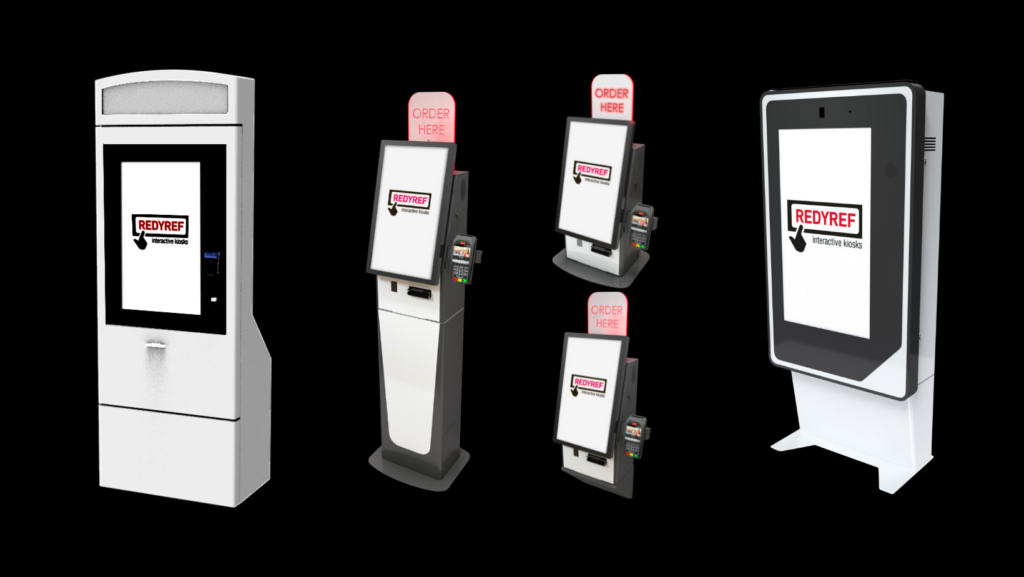


 The most significant growth in unattended retail is fresh meal vending serving locations where traditional food service is impractical or unavailable.